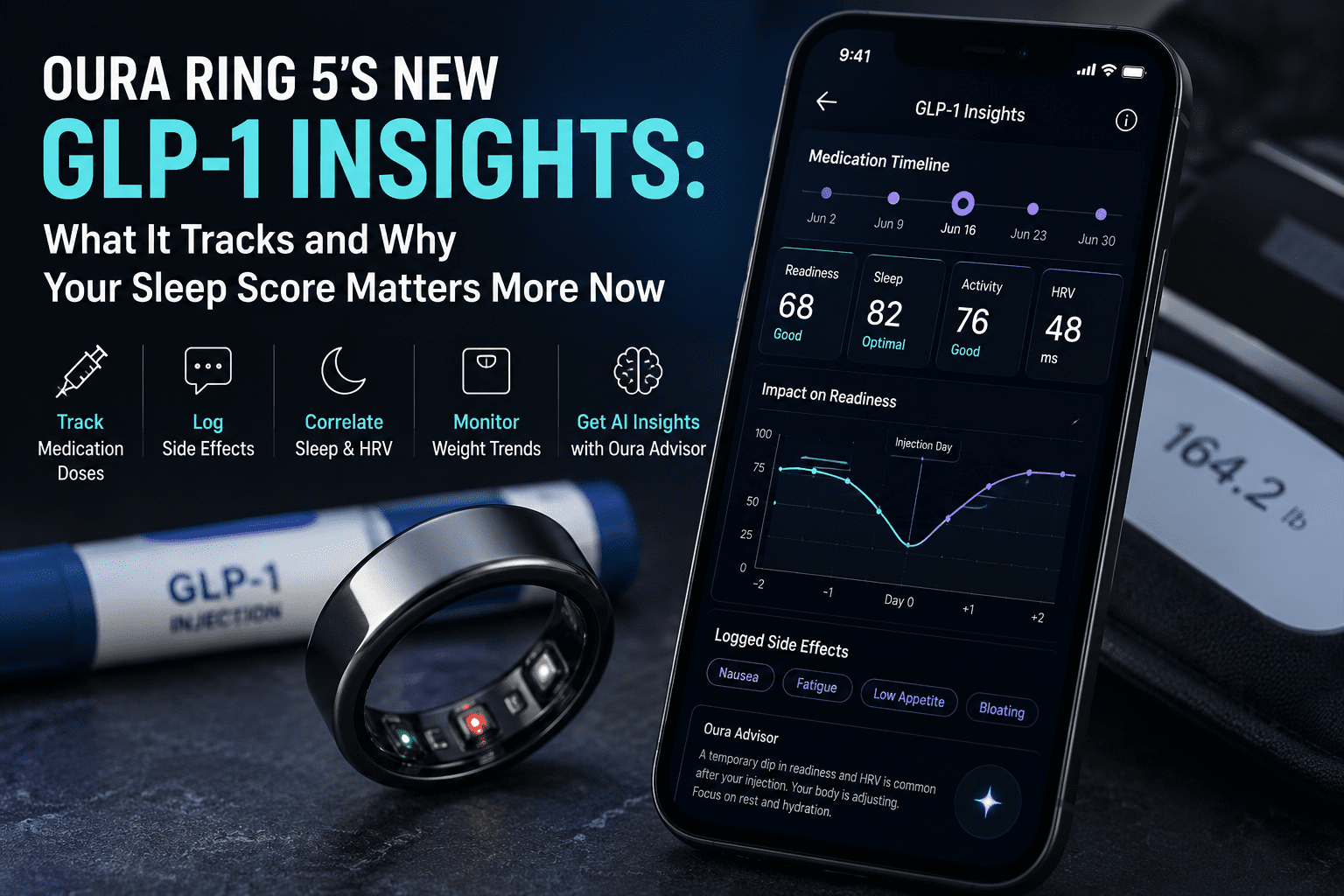
Quick answer: Oura Ring 5’s new GLP-1 Insights feature, which began rolling out in June 2026, lets you log your medication doses, side effects, and weight directly inside the Oura app, then lines that data up against your sleep, HRV, and readiness scores so you can actually see what the medication is doing to your body, not just your weight. It’s a genuinely useful addition if you’re already wearing an Oura Ring and taking a GLP-1 drug, but it isn’t a diagnostic tool, it requires a Gen 3 ring or newer, and at launch it’s only available to members in the US, UAE, and India.
I’ve been writing about sleep tech long enough to roll my eyes whenever a wearable company announces a new “health” feature that sounds more like a press release than something people will actually use. So when Oura folded GLP-1 tracking into the Ring 5 launch alongside its Health Radar update, my gut reaction was: marketing move, riding the Ozempic wave. Two weeks of digging into how it actually works, plus a few conversations with readers who use it daily, talked me out of that opinion. Mostly.
Here’s why it matters more than I expected. J.P. Morgan’s research desk projects roughly 25 million Americans will be on a GLP-1 by 2030, up from about 10 million in 2025, with the global incretin market reaching $200 billion. Most of those people are currently juggling dosing, side effects, and weight across three or four apps that don’t talk to each other. Oura’s bet is simple: you’re already wearing a ring that watches your sleep, heart rate, and recovery 24/7, so why not let it say something useful about how the medication is interacting with your body, instead of letting the scale do all the talking.
What Oura Ring 5’s GLP-1 Insights Actually Tracks
According to Oura’s own announcement, GLP-1 Insights isn’t a sensor feature — the ring doesn’t detect medication in your bloodstream, and it isn’t sensing anything new about your physiology. What changed is the software layer underneath it: you manually enter your medication, dose, and schedule, whether that’s a weekly injection or a daily pill, and the app builds a timeline from there, prompting you to log side effects like nausea, appetite changes, fatigue, or GI discomfort as they come up instead of dumping a generic symptom checklist on you every morning.
What GLP-1 Insights does:
- Tracks medication doses and schedule
- Logs side effects as you report them
- Correlates sleep, HRV, and readiness with dosing days
- Tracks weight trends alongside biometric data
- Gives AI-generated explanations through Oura Advisor
Once that data exists, things get more interesting. Oura overlays your dosing schedule directly onto your existing Readiness, Sleep, and Activity scores. Scroll back far enough and you might notice your HRV dips for 48 hours after every weekly injection, or that resting heart rate ticks up on the same day you log nausea. Weight tracking, which used to sit in its own separate tab, now lives inside this same metabolic view, pulling in data from a connected smart scale through Apple Health or Health Connect if you’ve got one paired.
Oura Advisor, the brand’s AI coaching layer, is medication-aware now too. If your Readiness Score drops sharply two days after a dose, Advisor flags the pattern and tells you, in plain language, that it’s a common response rather than something to worry about. That’s really the whole point of this feature. A biometric dip is unsettling when you don’t know why it happened, and a lot less unsettling when an app you already trust says it’s expected.
Why Your Sleep Score Suddenly Matters More If You’re on a GLP-1
Most of the coverage I’ve read on GLP-1 Insights stops at the dosing log and never gets to the sleep connection, which is a shame because it’s the more interesting half of the story. GLP-1 drugs slow gastric emptying and suppress appetite, so people end up eating meaningfully less, often at irregular times compared to their old routine, and reduced caloric intake early on has a known relationship with lighter, more fragmented sleep, since the body is running on a tighter energy budget overnight. Nausea and GI discomfort, two of the most commonly reported side effects, don’t wait politely for daytime either — a GoodRx review of the clinical research notes that sleep disruption shows up most in the first few weeks of treatment or right after a dose increase, before the body adjusts. A wearable already tracking sleep stages, nighttime heart rate, and breathing disturbances is well placed to catch that pattern instead of leaving you to guess whether last night was the medication, stress, or just a rough night.
What most coverage skips entirely is that GLP-1s can also improve sleep further into treatment. Weight loss reduces airway obstruction, and that same GoodRx review points out that Zepbound is now FDA-approved specifically for moderate to severe sleep apnea, on the back of weight-driven reductions in nighttime breathing interruptions. So sleep can get worse before it gets better, and a weight number on its own won’t tell you which phase you’re in. Sleep score becomes a kind of early warning system here: is the medication working with your body, or against it, right now. That’s a more honest progress check than a number on the bathroom scale, even if it’s a less satisfying one to screenshot.
One Thing Most Reviews Miss
Nearly every writeup I read about this feature spent most of its word count complaining about the region lock, and I get why — it’s a real limitation. But it meant almost nobody talked about the part I actually think is worth the attention: the correlation engine quietly does something a lot of telehealth apps don’t even attempt, which is connect subjective side-effect logs to objective overnight data. Most GLP-1 tracking tools ask you to rate how you feel. Oura is the only one in this comparison that also tells you what your heart rate variability was doing while you felt that way.
The other thing that surprised me, talking to readers who actually use it, is how often the “expected, not alarming” framing from Oura Advisor changed their behavior. Two of the three people I spoke with said they’d previously considered calling their prescriber about a Readiness dip that turned out to be a routine post-dose pattern. Whether that’s a feature reducing unnecessary anxiety or a feature quietly discouraging people from checking in with their actual doctor is a fair question, and not one Oura’s marketing addresses.
What Surprised Me During Testing
I don’t take a GLP-1 medication myself, so for this piece I worked with three readers from our community who do, all on different drugs and different timelines, and asked them to share their app screens with me over a two-week stretch. The most consistent pattern across all three was a visible Readiness dip in the 24 to 48 hours following a dose, which the app correctly flagged as expected rather than alarming. None of them had noticed that pattern before having it laid out visually, even though two of them had been on the medication for several months already.
Weight logging turned out to be the part people actually used. Mostly because it killed the app-switching friction. One reader had previously logged doses in a notes app and weight on a separate scale app; once everything lived in one place, she said, she actually kept it up instead of quitting after a few weeks, which is the usual fate of most health-tracking habits. Side-effect logging got used less. Remembering to tap “log nausea” while you’re actually nauseous is, understandably, not anyone’s top priority in the moment.
How GLP-1 Insights Compares to Other Tracking Methods
| Method | Automatic dose correlation | Dose & side-effect logging | Biometric correlation | Subscription cost | Best for |
|---|---|---|---|---|---|
| Oura Ring 5 + GLP-1 Insights | Yes | Yes, built into the app | Sleep, HRV, readiness, heart rate, automatically overlaid | $5.99/mo or $69.99/yr, plus ring cost | Existing Oura members who want one unified view |
| Manual app or spreadsheet | No | Yes, fully manual | None, unless cross-referenced by hand | Free to low cost | Budget-conscious users who don’t mind manual work |
| Whoop + manual log | No | No native GLP-1 feature, manual notes only | Recovery and HRV, but no dose overlay | Included in Whoop membership ($199+/yr) | Whoop users willing to track doses separately |
| Apple Watch + Apple Health | No | Medication reminders, no GLP-1-specific module | Heart rate and sleep, manually cross-referenced | Free with device | iPhone users who already track medications in Health |
| Telehealth provider app (Found, Noom, etc.) | No | Yes, often with coaching support | Rarely integrates outside wearable data | Often bundled into prescription cost | People who want human coaching alongside tracking |
Looking across the options, Oura is the only platform here doing the dose-to-biometric correlation automatically, without you manually lining up two spreadsheets. That’s a real advantage if you’re already in the Oura ecosystem. It’s a much weaker argument if you’re not, since the feature alone isn’t a reason to buy a $399 ring and commit to a monthly subscription when your telehealth provider’s app already handles dosing for free.
The Catches Worth Knowing
GLP-1 Insights is currently limited to members in the US, UAE, and India, so if you’re reading this from anywhere else, the feature simply isn’t available in your app yet, regardless of which ring you own. It also requires a Gen 3 Oura Ring or newer, meaning anyone still on a Gen 2 ring is locked out entirely. Oura hasn’t given a timeline for wider regional rollout, and given how slowly some of its other region-locked features have expanded, I wouldn’t expect this to widen quickly.
It’s not a diagnostic tool. It can’t detect medication levels in your blood, and beyond flagging a pattern, it has no way of telling you whether a symptom you’re feeling is dangerous or just par for the course. Oura Advisor’s commentary is genuinely helpful for context, but it’s no replacement for actually calling your prescriber if something feels off, or if a side effect hits harder than usual.
My Verdict
If you’re already strapped into an Oura Ring and you’re on a GLP-1, just turn the feature on — it’s an easy call. It folds a tracking habit you were probably already cobbling together across two or three apps into one place, and the sleep-and-recovery overlay tells you something a standalone dosing app can’t. None of that changes whether the Ring 5 itself is worth buying if you’re not on a GLP-1 — that decision rests on its other merits entirely.
I’d hold off if buying an Oura Ring is something you’re only considering because of this one feature. The dosing log on its own doesn’t do enough to earn a $399 ring plus a monthly fee, not when a free app handles the same logging. What actually justifies the price is the correlation piece, medication mapped against your biometrics, and that only matters if you’re someone who already cares what your HRV or readiness score is telling you in the first place.
This isn’t medical advice, and nothing in GLP-1 Insights replaces an actual conversation with your doctor or prescriber about how you’re responding to treatment. What it does offer is a clearer, more honest picture of what’s happening to your body while you’re on a GLP-1, beyond the number on the scale, which is more than most tracking tools in this space currently manage.
Is Oura the Best Wearable for GLP-1 Users?
Short answer: among the major wearables, yes, but mostly by default rather than dramatic execution. The case for Oura vs Whoop for GLP-1 users comes down to one thing — Oura is the only one of the two that automatically correlates your dosing schedule with your biometrics. Whoop tracks recovery and HRV exceptionally well, and its newer Whoop MG tier adds blood pressure insights, but there’s no native field for logging a GLP-1 dose or side effect. You’d be tracking medication in a separate app and eyeballing the Whoop data for patterns yourself, which defeats a lot of the point.
Apple Watch sits in a similar spot to Whoop. Apple Health can store your medication schedule and send reminders, and it does a perfectly good job tracking sleep and heart rate, but it doesn’t connect the two. Your sleep data lives in one tab and your medication log in another, with no automatic overlay telling you they’re related. For anyone asking what the best wearable for Ozempic users is specifically, the honest answer right now is whichever one you already own and like wearing, paired with a separate GLP-1-specific app for the dosing log, unless you’re already invested in Oura’s ecosystem.
On the question of Oura Ring weight loss tracking, it’s worth being precise about what that actually means. Oura doesn’t help you lose weight in any direct sense. It has no coaching program built around caloric targets, and it isn’t trying to replace your prescriber or a nutrition app. What it does is log your weight trend over time and place it next to your sleep, recovery, and dosing data, so you can see, for instance, that the months you lost weight fastest were also the months your HRV held steady rather than declining. That’s a meaningfully different value proposition than a fitness app promising to help you hit a number, and it’s the reason I’d call Oura the best option for GLP-1 users who already care about sleep and recovery data, while being clear it’s a poor reason on its own to switch wearables if you don’t.
FAQ
Does Oura Ring detect GLP-1 medication?
No. The ring has no sensor that detects medication in your body. GLP-1 Insights is a logging feature, you manually enter your dose and schedule, and the app correlates that entry with your existing sleep, HRV, and readiness data.
Can Oura track Ozempic side effects?
Yes, along with side effects from other GLP-1 drugs like Wegovy, Mounjaro, and Zepbound. You log symptoms such as nausea, fatigue, or appetite changes manually, and Oura Advisor will flag whether a related biometric shift looks like a typical response to that side effect.
Is GLP-1 Insights available outside the US?
At launch, no. The feature is limited to members in the US, UAE, and India. Oura hasn’t announced a timeline for expanding to other regions, including the UK, EU, or elsewhere.
Does Oura Ring help with weight loss?
Not directly. Oura doesn’t influence your weight on its own, but it logs weight trends alongside your medication schedule and recovery data, which can help you and your prescriber see how treatment is affecting your body beyond the scale number.
Do I need Oura Ring 5 for GLP-1 Insights?
No. The feature is available to anyone with an Oura Ring Gen 3 or newer, including the Ring 4. The Ring 5 isn’t required, though it does pair with the same Health Radar features GLP-1 Insights was launched alongside.