The RingConn vs Oura for sleep tracking decision mostly comes down to one recurring charge. RingConn does not require a subscription for any feature compared here. Oura’s full app requires a membership, which costs $5.99 a month or $69.99 a year in the US. Over two years, that adds about $138 to a hardware price that already starts higher.
What Oura offers in return is a published validation record for its sleep-staging algorithm, though that research used earlier rings. RingConn offers longer advertised battery life and, on two of its three models, a sleep apnea pattern feature without FDA clearance. If you are still deciding whether a ring is the right form factor at all, our guide to the best sleep tracking wearables compares rings with other options.
The rings at a glance
| Model | US list price | Required subscription | Main sleep-related distinction | Advertised battery | Key restriction |
|---|---|---|---|---|---|
| RingConn Gen 2 Air | $199 | None | Core sleep tracking, no apnea feature | Up to 10 days | No sleep apnea pattern insights |
| RingConn Gen 2 | $299 | None | Adds sleep apnea pattern insights | 10–12 days, by ring size | Apnea feature not FDA-cleared |
| RingConn Gen 3 | $349 | None | Apnea pattern insights plus overnight vascular trends | Up to 14 days | Gen 3 sizes differ from earlier RingConn rings |
| Oura Ring 4 | $349 | $5.99/mo or $69.99/yr | Same app and membership as Ring 5 | Up to 8 days | Detailed data requires membership |
| Oura Ring 5 | $399 | $5.99/mo or $69.99/yr | Newest Oura hardware | Up to 9 days | Detailed data requires membership |
| Samsung Galaxy Ring | $399.99 | None | FDA-cleared apnea risk feature announced, not yet confirmed live | Up to 7 days | Android only |
Which RingConn model matters for sleep
The sleep-related differences between RingConn’s three rings are smaller than the price gaps between them.
The Gen 2 Air and Gen 2 both estimate sleep stages and record overnight heart rate, blood oxygen and respiratory rate. On RingConn’s own product page, the Air is described as lacking sleep apnea monitoring. It also uses titanium steel instead of titanium and ships with a charging dock instead of a charging case. For sleep data, the extra $100 for the Gen 2 mainly buys the apnea feature.
RingConn’s comparison table lists sleep apnea pattern insights on both the Gen 2 and Gen 3. The Gen 3 adds vascular health trends, vibration alerts and a universal wireless charging case. It also stores 10 days of data offline, compared with 7 days on the Gen 2, which matters if the ring goes several nights without syncing to your phone. None of these additions establishes better sleep-tracking accuracy. If you mainly want sleep duration, timing and consistency, the Gen 2 Air records all of that.
What the Oura membership pays for
Without a membership, Oura shows three daily scores: sleep, readiness and activity. Detailed sleep analysis and long-term trends require an active membership, according to Oura’s membership support page.
New members get one included month, which starts when the ring is paired with the app. The membership is tied to the Oura account, not the ring. If you buy another ring on an existing account, you do not get a second free month. If you are choosing between the two current Oura models, our Oura Ring 5 vs Oura Ring 4 comparison covers the hardware differences.
Two-year ownership costs
“Two-year cost” here means total payments made during the first 24 months after purchase, with the ring bought in month 1. The figures assume a new Oura member who receives the included first month. An existing member buying a replacement ring would pay for that month too, adding $5.99.
two-year cost = hardware price + subscription payments made in months 1–24
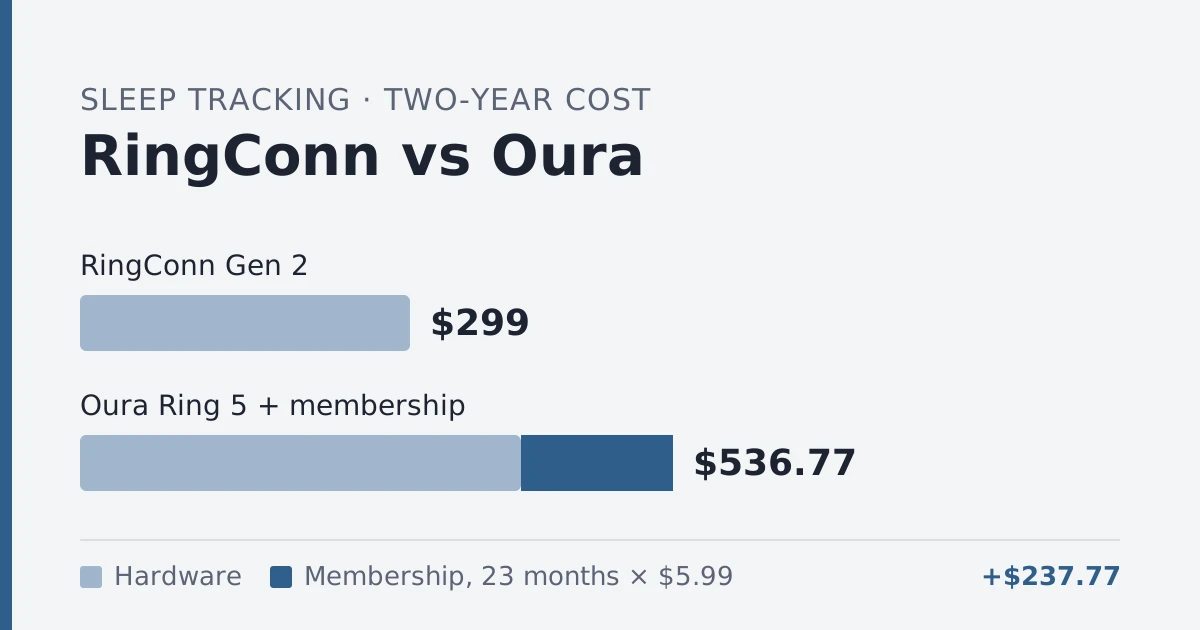
On the monthly plan, that is 23 paid months × $5.99 = $137.77. On the annual plan, the first $69.99 charge falls at the start of month 2 and the second at the start of month 14. That makes $139.98 inside the window, though the second payment covers access through month 25.
| Model | Hardware | Subscription, months 1–24 | Two-year total |
|---|---|---|---|
| RingConn Gen 2 Air | $199.00 | $0.00 | $199.00 |
| RingConn Gen 2 | $299.00 | $0.00 | $299.00 |
| RingConn Gen 3 | $349.00 | $0.00 | $349.00 |
| Samsung Galaxy Ring | $399.99 | $0.00 | $399.99 |
| Oura Ring 4, monthly plan | $349.00 | $137.77 | $486.77 |
| Oura Ring 5, monthly plan | $399.00 | $137.77 | $536.77 |
| Oura Ring 5, annual plan | $399.00 | $139.98 | $538.98 |
Inside a two-year window, the annual plan costs $2.21 more in cash than the monthly plan, because its second payment buys a month beyond the window. Kept longer, the annual plan is cheaper: $69.99 a year instead of $71.88.
These totals use list prices, which move often. At the time of checking, Samsung’s own store had the Galaxy Ring discounted to $279.99, and all four brands run regular sales. The structural difference changes less. RingConn and Samsung have no required recurring charge for these features; Oura’s membership continues for as long as you want detailed data.
For sleep features specifically, an Oura Ring 5 owner on the monthly plan pays $237.77 more over two years than a RingConn Gen 2 owner. The additional cost provides access to Oura’s detailed app features. Its published research is a separate consideration when assessing the evidence behind its estimates. The extra cost does not include an apnea feature, because Oura does not offer one comparable to RingConn’s or Samsung’s.
What the ring measures and what it estimates
Sleep duration and timing come from movement and physiological signals and are the most dependable output of any ring here. Sleep stages (light, deep and REM) are estimates. Sleep labs define stages from brain activity, which a ring cannot record, so it infers them from heart rate, heart rate variability, movement and temperature. Overnight trends in resting heart rate, skin temperature and blood oxygen are most useful against your own baseline.
Sleep and readiness scores are proprietary formulas. A RingConn score and an Oura score are built differently, so the same number on each app does not describe the same night. We explain why a single score can mislead in why smart ring sleep scores can be misleading. More sensors do not by themselves mean better accuracy; that depends on how the algorithm interprets the signals, and it has to be tested against a sleep-lab reference.
What the accuracy studies actually measured
Sleep/wake detection and sleep-stage classification are different tasks, and a percentage from one should not be compared with a percentage from the other.
Oura, 2021
A study in Sensors by two Oura-affiliated researchers analyzed 440 nights from 106 people against polysomnography. The full model reached 96% accuracy for two-stage classification (sleep versus wake) and 79% for four-stage classification (wake, light, deep and REM). The results came from cross-validation on the study’s own dataset, and the model became the basis of the staging algorithm Oura later shipped.
Oura, 2024
A University of Tokyo study in Sleep Medicine tested Oura’s Sleep Staging Algorithm 2.0 on 96 healthy Japanese adults aged 20–70, who wore one Gen 2 and two Gen 3 rings during polysomnography. Oura reports that total sleep time and time in light and deep sleep did not differ significantly from the lab reference. Oura says it partly funded the study but took no part in data analysis or writing.
Neither study tested the Ring 4 or Ring 5, so neither result transfers automatically to current hardware.
RingConn
RingConn advertises 90.7% sleep apnea monitoring accuracy on its Gen 2 product page. Coverage of the launch described the figure as coming from the company’s internal lab data. We did not find peer-reviewed validation of RingConn’s sleep staging or apnea detection on the Gen 2 or Gen 3.
The studies reviewed here do not establish which current model has the most accurate sleep staging.
Overnight breathing features
The FDA cleared Samsung’s Sleep Apnea Feature v2.0 (K261011) through the 510(k) pathway on July 20, 2026. The clearance covers that software feature, not the ring’s other health functions. Samsung said it would reach the Galaxy Ring through an update in fall 2026 but gave no date. The earlier watch version needed a compatible Samsung Galaxy watch and phone and was intended for people over 22 without an existing sleep apnea diagnosis. Samsung has not published the equivalent requirements for the ring. Until the update ships and those requirements are known, it is not a reason to buy the ring today.
RingConn’s sleep apnea pattern insights work on iPhone and Android but have no FDA clearance; RingConn’s Gen 3 page states that its rings are not medical devices. On the Gen 2, RingConn notes that enabling the feature may increase power consumption. Oura reports breathing disturbances during sleep but does not offer an apnea risk assessment.
No ring can diagnose sleep apnea, and a normal result does not rule it out. Even a cleared feature only flags risk. Loud snoring, gasping at night or persistent daytime sleepiness are reasons to talk to a doctor, not to buy a ring.
Battery life and missed nights
All battery figures here are manufacturer claims, and real results vary with ring size, settings and battery age. RingConn’s Gen 2 page, for example, lists up to 10 days for sizes 6–7 and up to 12 days only for sizes 12–14.
The practical risk to sleep data is not charging but forgetting to put the ring back on before bed. Longer battery life means fewer of those moments, which matters more if you want an unbroken long-term trend than if you check your sleep now and then.
Which ring fits which buyer
Low budget, mainly interested in sleep duration and consistency. The RingConn Gen 2 Air covers this at the lowest two-year cost in the comparison. Spending more buys features beyond that question.
A detailed app and long-term trends. Oura is the stronger fit if you accept a recurring fee. You are paying for the app, its guidance and a published research record, not for extra sensors.
Phone compatibility. iPhone users can rule out the Galaxy Ring. RingConn supports iOS 17 and Android 10 or later; Oura works with both platforms. Android users interested in Samsung’s apnea feature should wait until Samsung publishes which phones the ring version supports.
Questions the specs don’t answer
If I cancel my Oura membership, can I still see my past data?
Your data is not deleted when you cancel, provided you keep your account. Without a membership, the app shows only the three daily scores, but Oura’s support page says you can still export all of your data as CSV files from the Membership Hub. Rejoining restores access in the app.
If I replace my ring, is my sleep history kept?
Within the same brand, yes, if you stay on the same account. Oura ties membership and data to the account rather than the ring. RingConn’s product pages say each account pairs with one ring at a time, and that you keep your history by unpairing the old ring before pairing the new one. Data that never synced from the old ring may be lost. Switching brands does not carry history across apps, although Oura lets you export your data first.
- RingConn Gen 3 product page and model comparison
- RingConn Gen 2 product page
- RingConn Gen 2 Air product page
- Oura Membership support page
- Oura Ring 5 store page and Oura Ring 4 store page
- Samsung Galaxy Ring US store page
- Altini & Kinnunen, Sensors 2021
- University of Tokyo validation study (Oura summary)