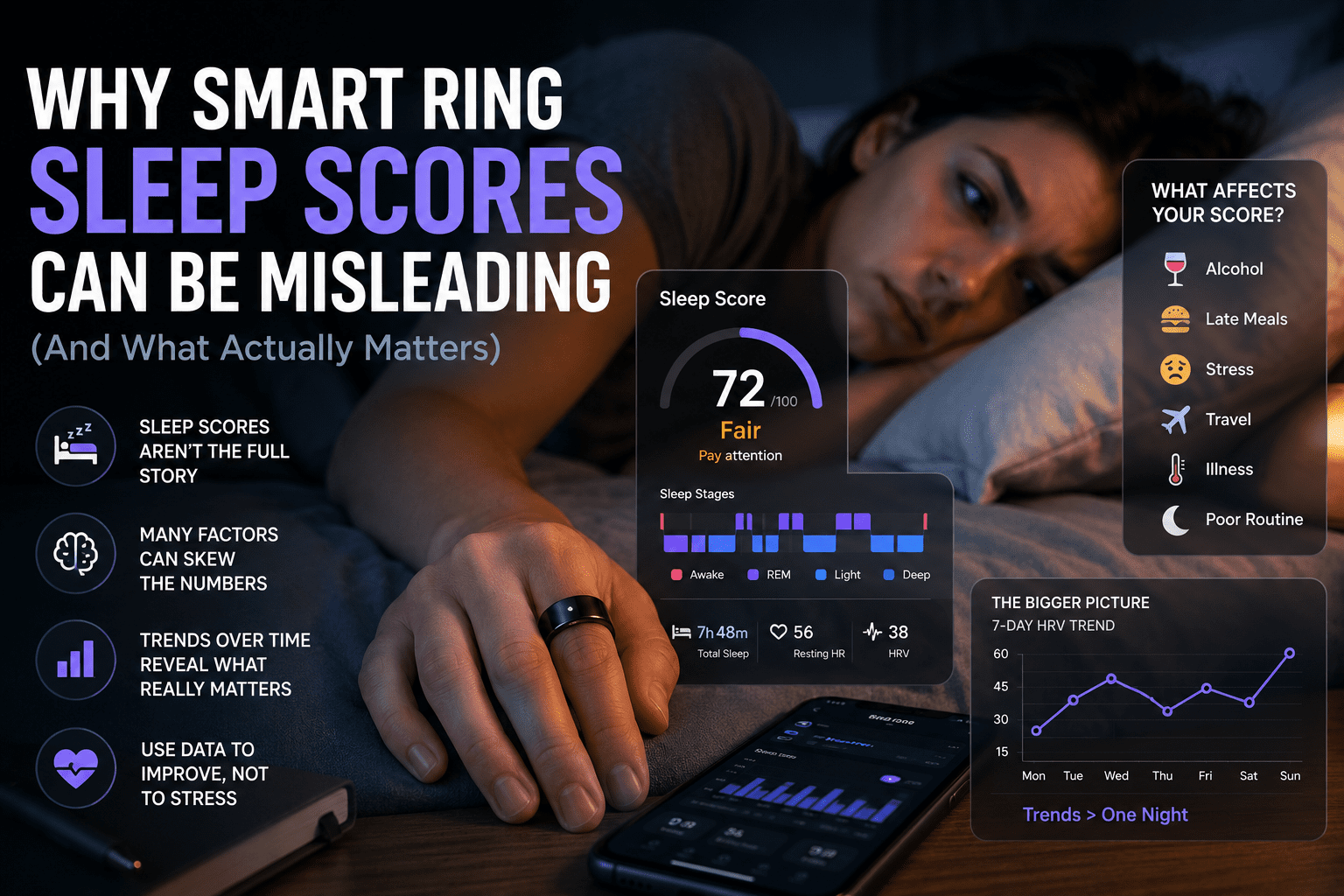
Every morning, millions of people glance at their finger or wrist and see a number: “Sleep Score: 73.” Some feel relieved. Others feel vaguely anxious. Many plan their entire day around it. If that sounds familiar, you’re not alone — and there’s a real problem worth unpacking here.
Smart rings and wearable devices have genuinely democratized sleep tracking. But that convenience comes with a serious risk: believing a single composite number accurately reflects your sleep quality. At RestGadgets, we test these devices closely, and the research tells a far more nuanced story.
What the Research Actually Shows
79%Best-case sleep staging accuracy for consumer wearables vs. PSGSleep Medicine Reviews, 2023
43%Users who felt more anxious after seeing a low scoreJournal of Clinical Sleep Medicine, 2022
26 minAverage deep sleep margin of error compared to clinical PSGNature Science of Sleep, 2024
1 in 3Nights rated “excellent” by device where users still woke up fatiguedStanford Sleep Lab, 2023
📌 Context
The gold standard for sleep research is polysomnography (PSG) — a clinical test that directly measures brain waves via EEG, muscle activity, and eye movement. Smart rings use optical heart rate sensors and accelerometers instead. They are estimating, not measuring.
How Sleep Scores Are Calculated — And Where They Break Down
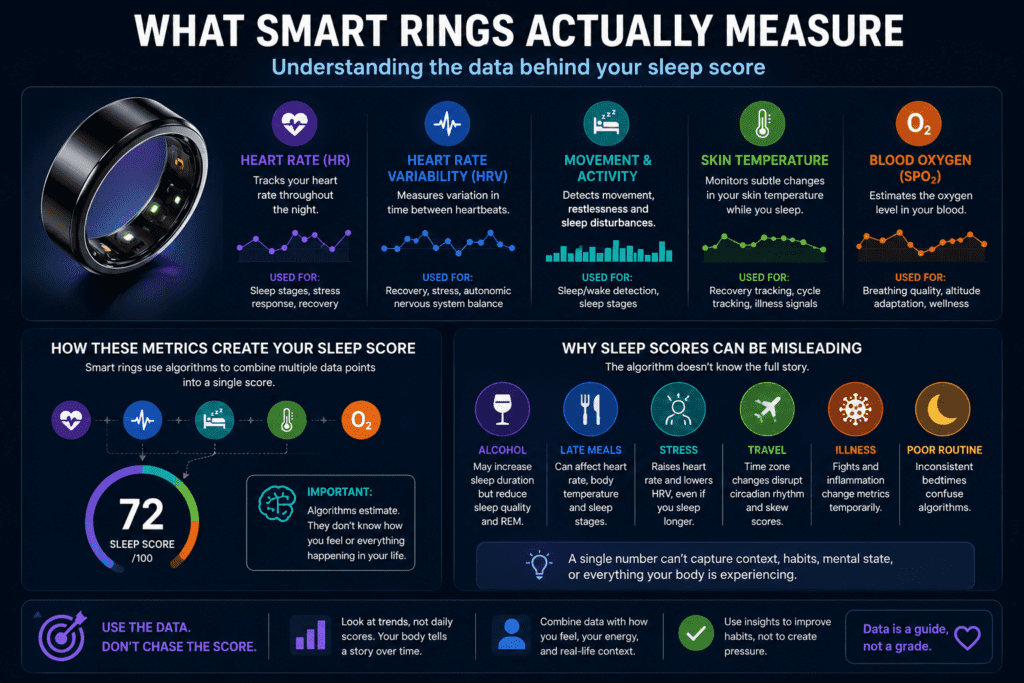
Devices like the Oura Ring and WHOOP estimate sleep stages — REM, deep, and light — using photoplethysmography (PPG) for heart rate and an accelerometer for movement. This data is processed by a proprietary machine learning model, producing a single number.
The problem is fundamental: accurate sleep staging requires EEG to read brain activity. Pulse and movement data are useful proxies, but they are not clinically reliable — especially for deep sleep, which shows the highest error rates of any measured stage.
Metric
Device Accuracy vs. PSG
Reliability
Total sleep duration
±20–30 min deviation
Moderate
Deep sleep (SWS) staging
60–69% accuracy
Low
REM sleep staging
70–75% accuracy
Moderate
General sleep/wake detection
85–92% accuracy
Good
HRV measurement
88–94% accuracy
Good
⚠️ Worth noting: A reading of “Deep Sleep: 45 minutes” carries a ±26-minute margin of error. Your actual value could be anywhere between 19 and 71 minutes — a range that renders the specific number nearly meaningless on any given night.
What Actually Matters — 4 Metrics Worth Trusting
💓
Morning HRV Trend
Reflects autonomic nervous system balance. A declining trend across 1–2 weeks is one of the earliest indicators of under-recovery — far more actionable than a nightly score.
🌡️
Resting Heart Rate
Night-over-night elevations signal illness, alcohol intake, or excessive fatigue. Weekly trends tell the story; a single elevated reading rarely does.
😴
Subjective Restfulness
How rested you actually feel on waking is often more predictive of recovery quality than any algorithm-generated composite score.
⏰
Sleep Consistency
Going to bed and waking at consistent times anchors your circadian rhythm. Research shows this matters more long-term than any single-night high score.
“Orthosomnia” — When Score-Chasing Becomes the Problem
In 2022, the Journal of Clinical Sleep Medicine identified a new clinical phenomenon among wearable users: orthosomnia — an obsessive pursuit of a perfect sleep score that paradoxically disrupts the sleep it’s meant to optimize.
🔍 Research Finding
28% of study participants reported feeling more fatigued the morning after seeing a poor sleep score — even when their actual sleep duration had not changed. Researchers identified this as the nocebo effect: a negative expectation producing real physiological symptoms. When your device tells you that you slept badly, your brain processes it as a stress signal. And stress genuinely degrades recovery quality — creating a self-reinforcing loop.
The device designed to help you sleep better can end up making sleep worse. That’s not a hypothetical edge case — it’s a documented pattern affecting a significant share of consistent wearable users.
How to Use Your Device Without Being Misled by It
You don’t need to abandon your ring. You need to change how you interpret it. The single most useful reframe: your wearable is a trend monitor, not a verdict machine. Two weeks of declining HRV is a signal. One night at 65 points is noise.
Resist the urge to check your sleep data as the first thing you do each morning. Start with a self-check instead: “Do I feel rested?” Then open the app. When your subjective experience and the device data are in consistent conflict, that’s worth discussing with a sleep specialist — not something to resolve by obsessively refreshing your metrics.
For a detailed breakdown of which smart rings track HRV and recovery most accurately, visit RestGadgets.com.
Bottom Line
“A sleep score is useful the way a metaphor is useful — it points toward something real, but it is not the thing itself. How you feel will always be a more reliable signal than what an algorithm tells you.”
Frequently Asked Questions
How accurate are smart ring sleep scores?
Consumer smart rings achieve sleep staging accuracy between 69–79% compared to clinical polysomnography. Deep sleep readings can carry error margins of up to 26 minutes per night. The most reliably measured metrics are HRV and general sleep/wake detection — not granular stage breakdowns.
What sleep metric actually matters more than a score?
Morning HRV trend, resting heart rate over time, subjective restfulness, and sleep consistency are all more predictive of true recovery than a composite score. Look at 2-week trends rather than individual nightly numbers for meaningful insight.
Why is HRV more reliable than a sleep score?
HRV directly reflects autonomic nervous system balance and recovery capacity. It’s validated in scientific literature as a biomarker for sleep quality, cardiovascular health, and stress resilience — and devices measure it with 88–94% accuracy, far outperforming sleep stage estimation.
What is orthosomnia?
Orthosomnia is a term from the Journal of Clinical Sleep Medicine describing obsessive behavior around achieving a perfect wearable sleep score. It increases anxiety and paradoxically worsens actual sleep quality — a self-reinforcing cycle where the tracker itself becomes the disruptor.
Should I stop using my smart ring for sleep tracking?
Not necessarily — but reframe how you use it. Treat it as a trend monitor, not a daily verdict. A declining HRV trend over two weeks is worth acting on. A single night scoring poorly when you feel fine is not. Persistent mismatches between your subjective feel and device data are worth raising with a sleep specialist.
Sources
1. Chinoy, E.D. et al. — Sleep Medicine Reviews (2023). Performance of seven consumer sleep-tracking devices compared with polysomnography.
2 thoughts on “Why Smart Ring Sleep Scores Can Be Misleading (And What Actually Matters)”