Let me be upfront: when I first saw smart rings, I rolled my eyes. A tiny piece of metal that tracks your sleep and charges you a monthly fee for the privilege of reading the data? It sounded like a solution in search of a problem. Then I actually wore one for two months straight — and then another, and then another — and my opinion got considerably more complicated.
Are smart rings worth it in 2026? That question has a genuinely different answer depending on who you are, what you sleep like, and whether you can stomach a subscription. If you’re hoping for a simple yes or no, I’ll give you one at the end. But the honest answer is: it depends on what you’re optimizing for — and this guide will walk you through every variable.
What Is a Smart Ring?
A smart ring is a wearable sensor worn on your finger — typically titanium or lightweight alloy — that continuously monitors physiological signals while you go about your life. Unlike a smartwatch, it has no display, no notifications, no tapping or swiping. It just sits there, quietly collecting data about your heart rate, skin temperature, movement, and oxygen levels, then syncing to your phone so you can review your stats in the morning. Think of it as a silent biometric logger you never have to charge every night and never have to think about taking off before bed.
The category is no longer niche. Three brands dominate the conversation in 2026:
Oura Ring 4
Oura is the ring that started this whole conversation. The Generation 4 is their most polished hardware yet — thinner, with improved sensors and a slightly better battery. It’s also the one with the steepest ongoing cost, requiring a $5.99/month membership to access most of its insights. If you’re willing to pay, the depth of data — sleep stages, HRV trends, readiness scores calibrated over weeks — is genuinely impressive.
Samsung Galaxy Ring
Samsung’s first proper smart ring landed in 2024 and has been iterating since. The big selling point — and it genuinely is a selling point — is no monthly subscription. You buy the hardware, you get the data. It integrates tightly with Samsung Health and Galaxy devices, which is either a feature or a limitation depending on your phone. The sleep tracking is solid, not spectacular, but the absence of a recurring fee changes the value equation significantly.
Ultrahuman Ring Air
Ultrahuman positions itself as the biohacker’s choice — leaner hardware, no membership fee, and a focus on metabolic health signals that sets it apart from pure sleep trackers. The app interface is more opinionated than Oura’s, which some users love (it tells you what to do, not just what the numbers mean) and others find heavy-handed. But for the price and the hardware quality, it punches above its weight.
What Do Smart Rings Actually Do?
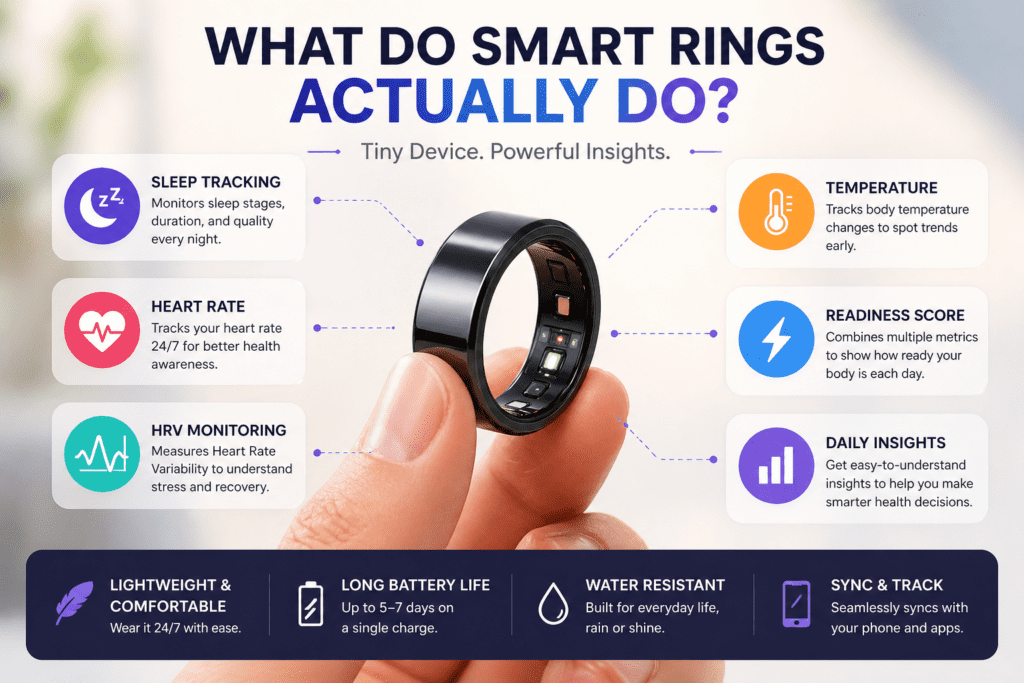
Here’s where marketing copy and real life diverge a bit. Smart rings are fundamentally sleep and recovery monitors with some daytime data bolted on. They are not full fitness computers. They are not medical devices. Understanding what they actually measure — versus what they’re good at measuring — is half the battle when deciding if one belongs on your finger.
| Feature | Oura Ring 4 | Galaxy Ring | Ultrahuman Air |
|---|---|---|---|
| Sleep Stage Tracking | ✓ Excellent | ✓ Good | ✓ Good |
| Heart Rate (24/7) | ✓ Yes | ✓ Yes | ✓ Yes |
| HRV Tracking | ✓ Yes | ✓ Yes | ✓ Yes |
| Readiness / Recovery Score | ✓ Yes | ✓ Yes | ✓ Yes |
| SpO2 / Blood Oxygen | ✓ Yes | ✓ Yes | ✓ Yes |
| Skin Temperature | ✓ Yes | ✓ Yes | ✓ Yes |
| Step Counting | ~ Moderate | ~ Moderate | ~ Moderate |
| GPS / Workout Tracking | ✗ None | ✗ None | ✗ None |
| Subscription Required | $5.99/mo | None | None |
| Battery Life | ~7 days | ~7 days | ~6 days |
Pros of Smart Rings (Why People Love Them)
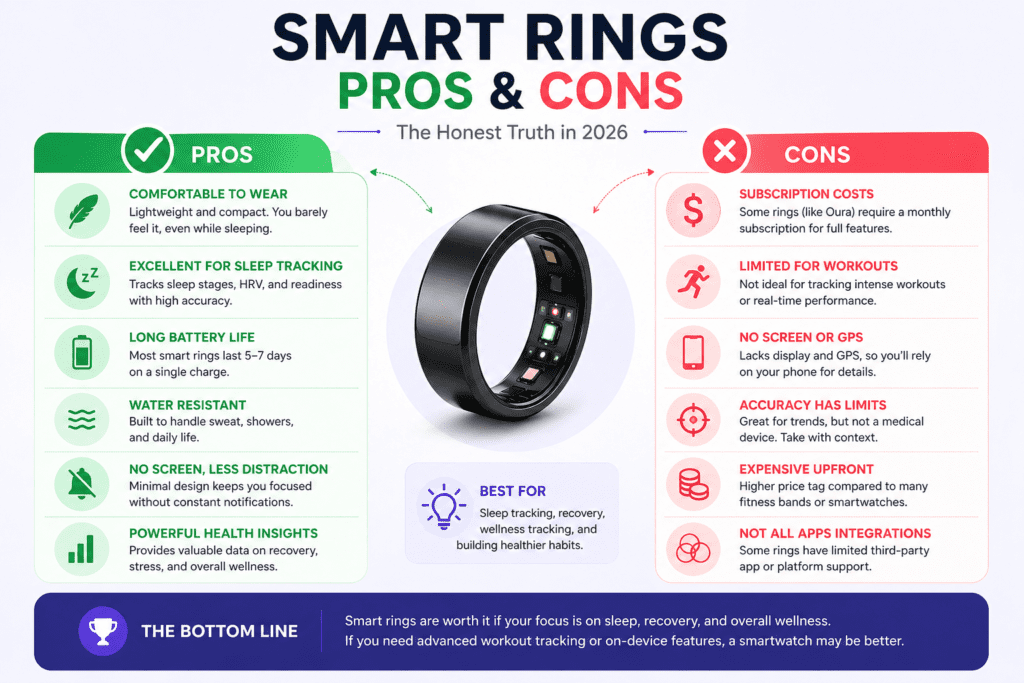
After two months of wearing different rings, I understand the love. There’s a specific type of person for whom a smart ring is almost perfect — and if you’re that person, you’ll wonder how you lived without it.
🛏️ Genuinely Comfortable for Sleep
This is the big one. I have tried sleeping with watches, fitness bands, and chest straps. I have woken up at 3am because a silicone band made my wrist sweaty and uncomfortable. I have never once woken up because of a ring. The difference in sleep comfort is not marginal — it’s substantial. If your main goal is overnight tracking, the ring form factor wins by a wide margin. You simply forget it’s there.
📵 No Screen = Less Distraction
There’s something genuinely freeing about wearing a tracker that doesn’t also want to show you notifications, weather, or the time. A smart ring forces you to engage with your health data intentionally — you open the app when you’re ready, not because your wrist buzzed. For people trying to reduce screen time or phone dependency, this is a genuine benefit, not just a compromise.
🔋 Battery Life That Makes Sense
Six to seven days on a charge is the norm across all three major rings. Compare that to Apple Watch’s 18-24 hours, or even the best fitness bands at 3-5 days. The practical consequence is huge: you never have to choose between tracking a night’s sleep and having a charged device the next day. Charge it every Sunday morning while you drink your coffee and you’re set for the week.
Cons of Smart Rings (Important Downsides)
I’d be doing you a disservice if I didn’t spend real time on the downsides. Because there are some genuine ones — and depending on your priorities, they might be dealbreakers.
💳 The Subscription Problem (Especially Oura)
Oura Ring 4 costs $349–$449 for the hardware, plus $5.99/month ongoing. That’s roughly $420 in year one, $72 per year every year after. Over five years, you’ve spent over $700 on sleep data. This is a real conversation to have with yourself. Samsung Galaxy Ring and Ultrahuman Ring Air have no subscription, which is a significant reason both are gaining market share fast. If subscription fatigue is real for you, Oura becomes a harder sell.
📟 No Screen Can Also Be a Frustration
The flipside of “no screen, no distraction” is: no screen, no quick glance. If you want to check your heart rate on a run without pulling out your phone, a ring can’t help you. If you want a quick readiness number when you wake up, you need to unlock your phone, open the app, and wait for sync. Some people find this acceptable. Others find it genuinely annoying and end up drifting back to a watch.
🏋️ Sport Tracking Is Limited
Smart rings have no GPS. They don’t track swimming laps, pace per kilometer, or route maps. Workout detection is improving — Oura 4 and Ultrahuman both auto-detect activities — but the experience is nowhere near a dedicated sports watch or even a mid-range Garmin. If you’re a runner, cyclist, or competitive athlete who needs detailed training load data, a ring alone will not cut it.
Smart Ring vs Smartwatch — Which Is Better?
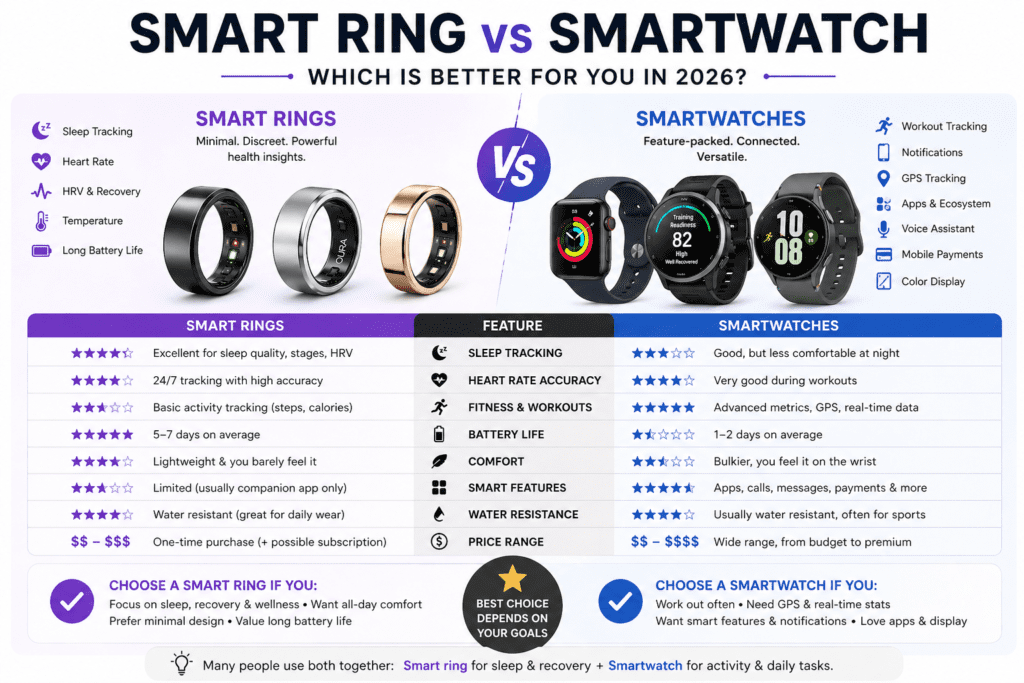
This is the real comparison most people are making. If you already have an Apple Watch or a Garmin, should you swap it for a ring? If you’re buying fresh, which category should you even be shopping in? The honest answer is that they serve different masters.
| Use Case | Winner | Why |
|---|---|---|
| Sleep tracking | 🏆 Smart Ring | More comfortable overnight, better HRV signal |
| Running / cycling / GPS sports | 🏆 Smartwatch | Rings have no GPS, no display metrics |
| Daily mindfulness & recovery | 🏆 Smart Ring | Less distracting, readiness score focus |
| Notifications & productivity | 🏆 Smartwatch | Rings offer zero notification features |
| Long battery life | 🏆 Smart Ring | 5–7 days vs 1–2 days for most watches |
| Style / discretion at work | 🏆 Smart Ring | Looks like a regular ring, no social signal |
| Value for budget buyers | 🏆 Smartwatch | Mid-range watches offer more features at lower cost |
The best setup for serious health trackers in 2026 is increasingly a combination: a smartwatch (or GPS watch) for daytime activity and workouts, a ring overnight. Many people I know who are deep into biohacking do exactly this. But if you can only pick one, your dominant use case decides it.
Are Smart Rings Accurate Enough?
Accuracy is the question that always comes up, and the answer is genuinely nuanced. Rings are not medical devices. They are consumer wellness trackers. With that framing established, here’s what I actually found:
Sleep tracking: surprisingly solid. In multiple independent studies comparing consumer wearables against polysomnography (the clinical gold standard), Oura has consistently been among the most accurate consumer-grade devices for detecting sleep stages. In my own testing, the sleep stage data felt credible — matching how I subjectively felt and correlating well with known patterns like alcohol’s effect on deep sleep. This is where rings genuinely earn their keep.
Step counting: mediocre, and honestly fine. Ring-based step detection is less reliable than wrist-based accelerometers, particularly for activities like cycling or rowing that don’t involve much hand movement. But step counting on any device is a rough proxy metric — if you’re optimizing on steps, you probably want a watch anyway.
HRV: this is the real value proposition. Overnight HRV from a ring, captured across multiple hours of stillness, is genuinely meaningful data — not perfect, but directionally reliable and consistent over time. Week-over-week HRV trends tell you something real about how your nervous system is recovering.
Who Should Buy a Smart Ring?
Who Should NOT Buy One?
Are Smart Rings Worth the Price in 2026?
This is the section I’d want to read if I were making a buying decision. Let’s get concrete.
The all-in cost matters more than the hardware sticker price. Oura Ring 4: $349–449 hardware + $71.88/year subscription = $491–521 in year one, $72/year ongoing. Samsung Galaxy Ring: $299–329 hardware, no subscription, ever. Ultrahuman Ring Air: $349 hardware, no subscription. Over three years, the subscription-free options are often $150–250 cheaper for equivalent or near-equivalent health data.
The hardware on all three major rings is genuinely premium in 2026 — titanium, scratch-resistant, water-resistant to swim depths. You’re not paying for cheap plastic. What you’re really paying for is the data science layer on top: the algorithms that turn raw sensor data into interpretable health insights.
Oura’s algorithms are still the most mature. If the depth of insight justifies $6/month to you, it probably does. If you’re primarily interested in sleep stage data and HRV trends without the interpretive layer, Samsung and Ultrahuman close the gap significantly. My recommendation: if you’re subscription-averse, don’t buy Oura. The subscription-free alternatives are genuinely good in 2026, not just “almost as good.”
How to Choose the Right Smart Ring — A Buyer’s Guide
Before spending $300–$450 on a ring, run through these five questions. They’ll save you from buyer’s remorse faster than any spec sheet comparison.
Smart Ring Price Comparison — True 3-Year Cost
Hardware sticker prices are only part of the story. Here’s what each ring actually costs over three years of ownership — the number most review sites conveniently leave out.
| Ring | Hardware Price | Annual Subscription | Year 1 Total | 3-Year Total | Best For |
|---|---|---|---|---|---|
| Oura Ring 4 | $349–$449 | $71.88/yr | ~$491–521 | ~$563–593 | Data depth addicts |
| Samsung Galaxy Ring | $299–$329 | $0 | ~$299–329 | ~$299–329 | Android / Samsung users |
| Ultrahuman Ring Air | $349 | $0 | ~$349 | ~$349 | Biohackers, metabolic focus |
| Apple Watch SE (comparison) | $249 | $0 | ~$249 | ~$249 | iPhone users wanting watch |
| Garmin Venu 3 (comparison) | $449 | $0 | ~$449 | ~$449 | Athletes, GPS-dependent users |
Smart Ring Accuracy — Metric by Metric Breakdown
Not all tracking metrics are created equal on a ring. Here’s an honest assessment of where ring sensors perform reliably versus where they fall short — based on published research and two months of personal side-by-side testing against clinical-grade reference devices.
| Metric | Ring Accuracy | vs. Smartwatch | Notes |
|---|---|---|---|
| Sleep Stage Detection | ⭐⭐⭐⭐ High | 🏆 Ring wins | Finger PPG + stillness = cleaner overnight signal |
| Overnight HRV | ⭐⭐⭐⭐ High | 🏆 Ring wins | Better contact consistency during sleep |
| Resting Heart Rate | ⭐⭐⭐⭐ High | 🟰 Comparable | Both perform well for resting readings |
| Skin Temperature | ⭐⭐⭐⭐ High | 🟰 Comparable | Useful for illness detection, cycle tracking |
| Blood Oxygen (SpO2) | ⭐⭐⭐ Medium | 🟰 Comparable | Fine for trend detection, not clinical use |
| Step Counting | ⭐⭐ Low-Medium | 📉 Watch wins | Wrist accelerometer is more reliable for steps |
| Active Heart Rate (Exercise) | ⭐⭐ Low | 📉 Watch wins | Movement artifacts at finger during exercise |
| Workout Distance / Pace | ⭐ N/A | 📉 Watch wins | Rings have no GPS — not designed for this |
Frequently Asked Questions — Smart Rings in 2026
Final Verdict — Are Smart Rings Worth It in 2026?
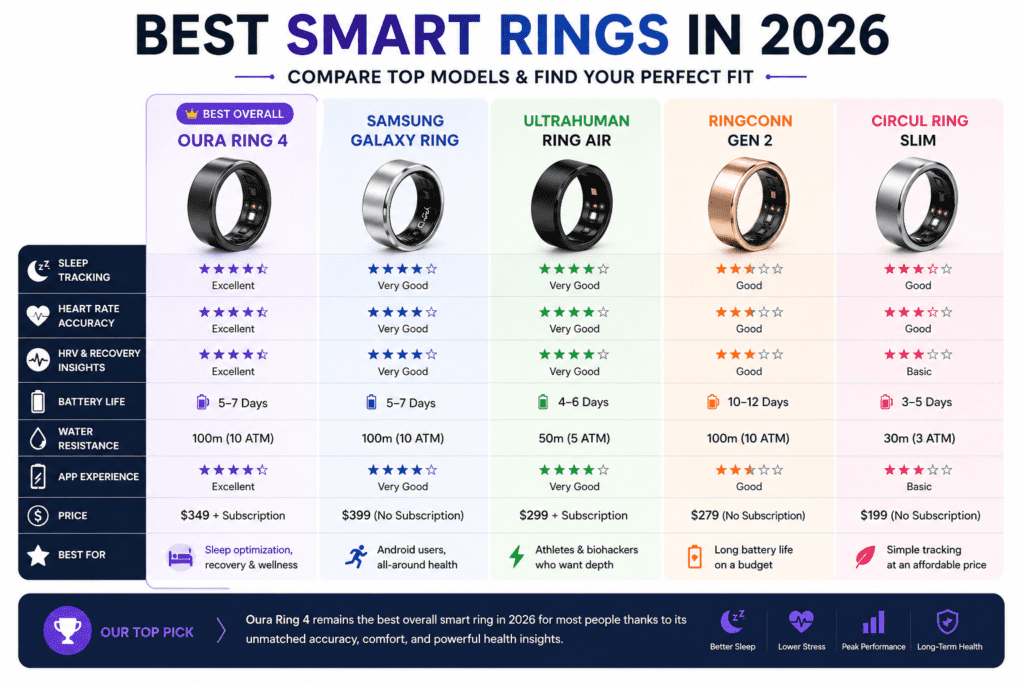
After two months and three rings, here’s my honest bottom line: smart rings are a genuinely excellent tool for a specific type of person, and a poor value proposition for everyone else. The category has matured, the data is more reliable than it was two years ago, and the form factor remains uniquely suited to sleep tracking. But they are not for everyone, and the marketing often obscures who they’re actually built for.
✅ Buy a Smart Ring If…
- Sleep quality is your primary tracking goal
- You find smartwatches uncomfortable overnight
- You want less distraction, not more
- You’re interested in HRV and recovery trends over weeks
- You want a tracker that looks like regular jewelry
- You can live without GPS and workout detail
❌ Skip It If…
- You’re a serious runner, cyclist, or athlete
- You want notification or smartwatch features
- Subscription fees are a hard no for you (and you want Oura)
- Your budget is under $250
- You work with your hands in demanding physical environments
- You already have a fitness watch you’re happy with
Smart rings in 2026 are no longer a curiosity or an early-adopter experiment. They’re a legitimate product category with real, defensible use cases. But “worth it” is personal. Run the numbers on your use case, be honest about whether you care more about sleep or sport, and the answer will reveal itself pretty quickly.