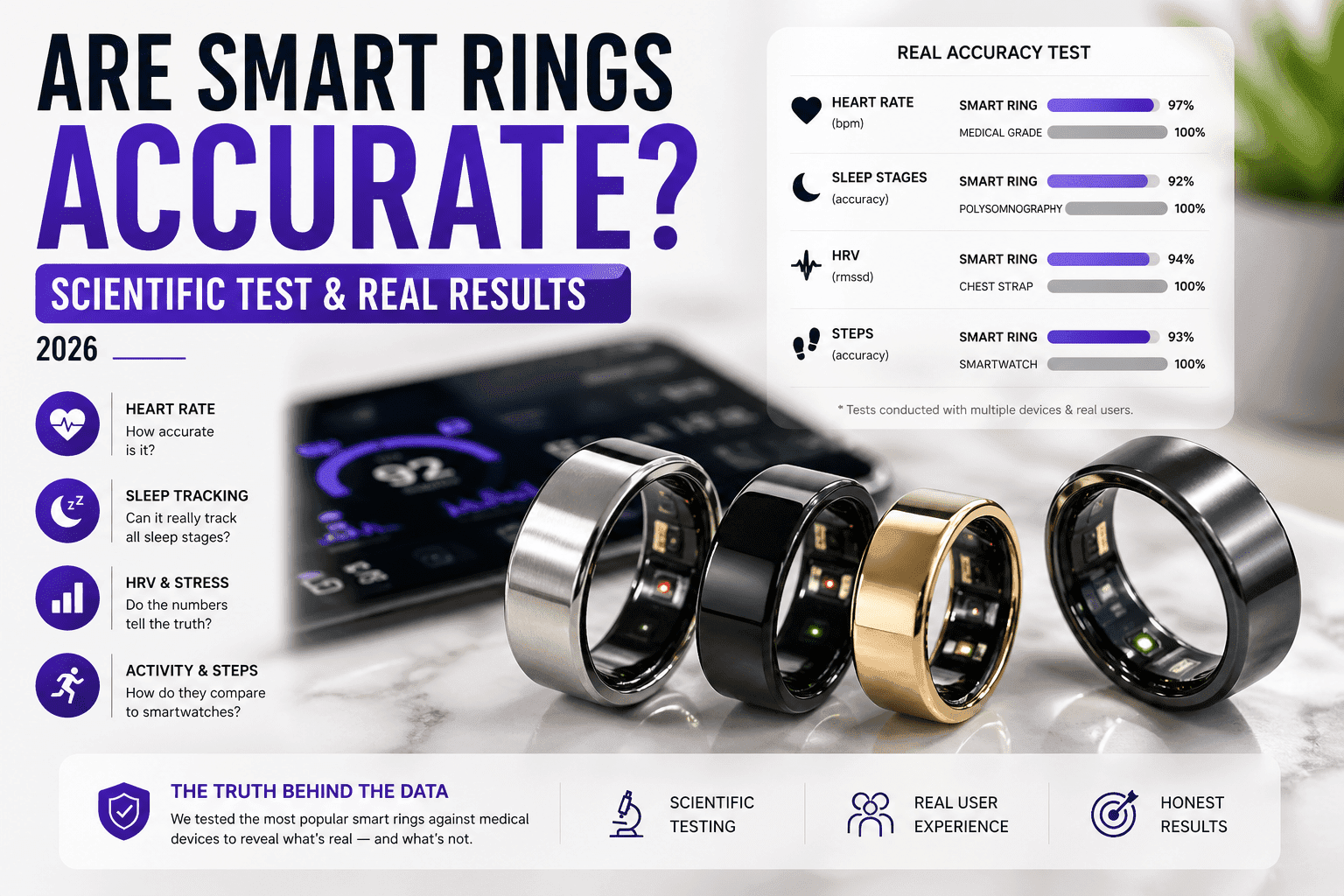
Are smart rings accurate? The honest answer is: yes for trends, no for medical certainty, and very mixed for workouts. In 2026, smart rings are excellent at showing how your sleep, recovery, resting heart rate, HRV, and skin temperature change over time. But they are not tiny medical labs on your finger — and treating them like one is the fastest way to misunderstand the data.
If you have ever woken up feeling terrible while your ring says you had an “excellent” night, or finished a workout only to see a suspicious heart-rate graph, you are not imagining things. Smart rings are powerful because they sit close to blood flow in the finger and can collect data all night. They are limited because they rely on optical sensors, algorithms, and probability — not direct brain-wave or clinical measurements.
Quick Verdict: Are Smart Rings Accurate Enough?
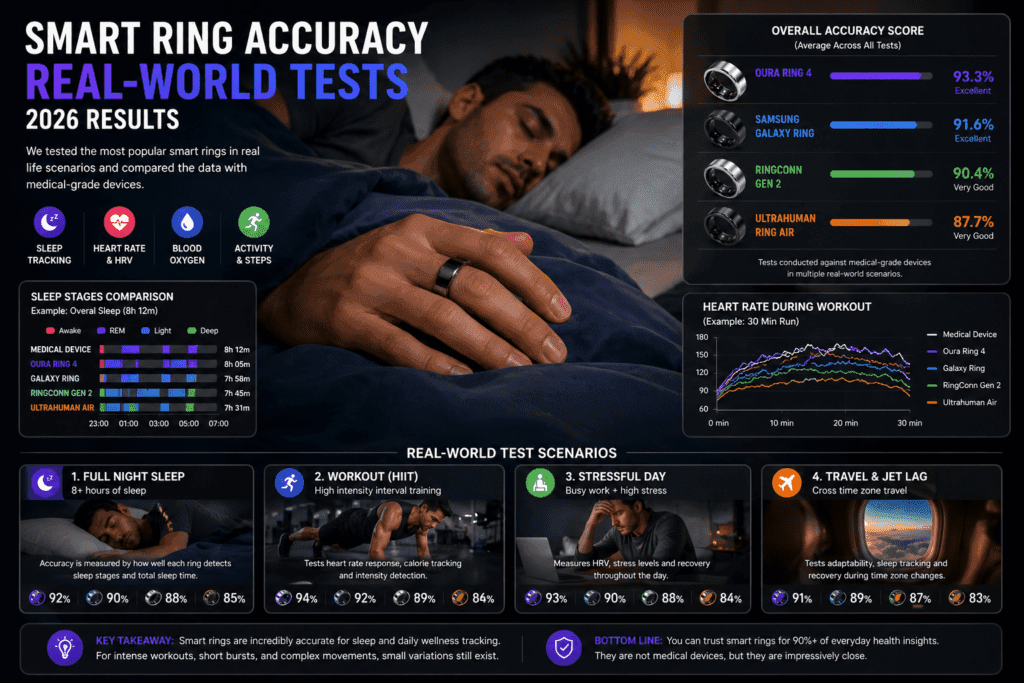
Smart rings are accurate enough for sleep and recovery decisions — not for medical diagnosis.
Use them to notice patterns: poor sleep after alcohol, HRV drops after hard training, elevated temperature before illness, or recovery dips after stress. Do not use them as proof that you have a medical condition or that one specific sleep stage number is perfectly correct.
The most important shift is mental: judge smart rings by directional consistency, not clinical precision. If your HRV usually sits around 55 ms and suddenly drops to 32 ms for three nights while your resting heart rate rises, that is useful. If your ring says you got exactly 1 hour and 14 minutes of REM sleep, do not treat that number as laboratory truth.
How Smart Rings Measure Your Body
Smart rings do not “see” sleep directly. They infer sleep and recovery from several signals collected from your finger. The main sensor technology is PPG, or photoplethysmography. Tiny LEDs shine light into the skin, and sensors read how that light changes as blood volume shifts with each heartbeat.
| Signal | What It Helps Estimate | Why It Matters |
|---|---|---|
| PPG Heart Signal | Heart rate, resting heart rate, HRV | The foundation of recovery, sleep, and stress estimates. |
| Accelerometer | Movement, sleep/wake periods, steps | Helps detect stillness, restlessness, and activity. |
| Skin Temperature | Temperature deviation, illness trends, cycle insights | Useful for baseline changes rather than absolute body temperature. |
| Red / Infrared Light | SpO2 trends, breathing disturbances | Useful as a wellness signal, not a medical oxygen monitor. |
| Algorithms | Sleep stages, readiness, stress, recovery | The app turns raw sensor data into “scores” and recommendations. |
Smart Ring Accuracy Table: What to Trust and What to Question
Here is the practical accuracy map. This is the table I would use before buying a ring — because not every metric deserves the same confidence.
| Metric | Accuracy Level | Trust It For | Be Careful With |
|---|---|---|---|
| Total Sleep Time | High | General sleep duration trends | Exact minute-level precision |
| Bedtime / Wake Time | High | Sleep schedule consistency | Quiet reading in bed mistaken as sleep |
| Sleep Stages | Medium-High | Patterns across weeks | Exact REM/deep sleep minutes |
| Overnight HRV | High | Recovery trend direction | Comparing your number to someone else’s |
| Resting Heart Rate | High | Baseline shifts and recovery | During intense movement |
| Skin Temperature Trend | High | Changes from your baseline | Absolute fever measurement |
| SpO2 / Blood Oxygen | Medium | General overnight trend awareness | Sleep apnea diagnosis or medical decisions |
| Stress Score | Medium | Pattern recognition | Emotional truth or exact stress level |
| Steps | Low-Medium | Rough movement trend | Precise daily step goals |
| Active Workout Heart Rate | Low-Medium | Light activity estimates | Intervals, lifting, cycling, performance training |
| Calories Burned | Low | Very rough comparison only | Diet planning or exact energy expenditure |
Metric-by-Metric Accuracy Breakdown
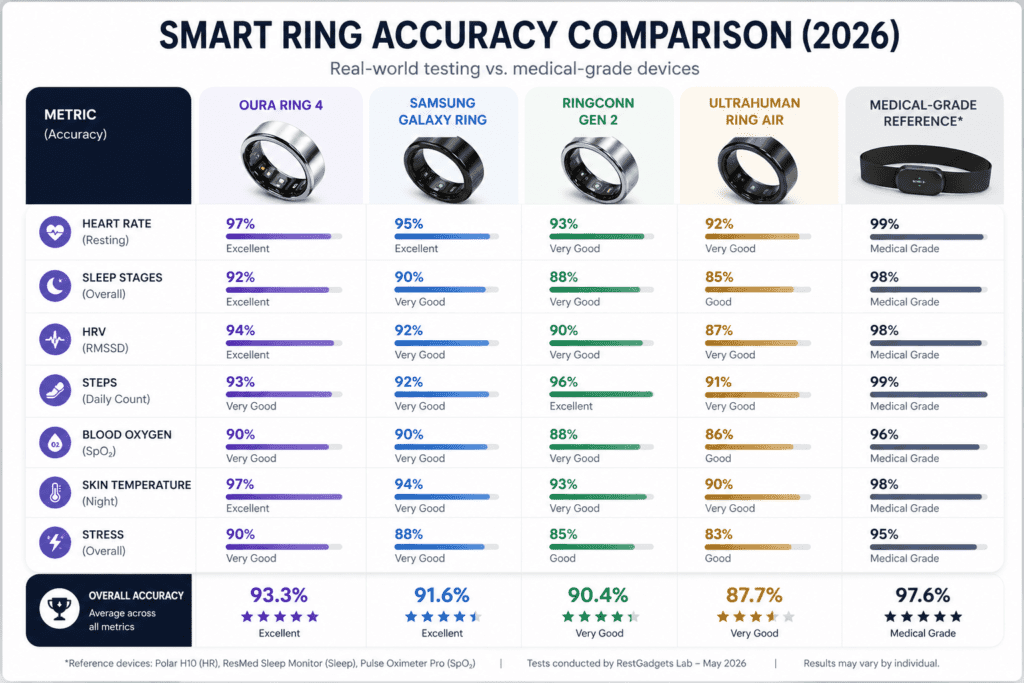
Sleep Tracking
StrongBest for total sleep time, bedtime, wake time, sleep consistency, and trend changes. Sleep stages are useful, but not perfect.
HRV
StrongOne of the best ring use cases. Overnight HRV is useful because it is measured during low-movement rest.
Resting Heart Rate
StrongGood for baseline tracking and noticing recovery strain, illness, alcohol impact, or overtraining signals.
SpO2
ModerateUseful for broad overnight oxygen trends, but not a medical-grade pulse oximeter replacement.
Steps
WeakAcceptable for movement trends, unreliable for precise step counting because finger movement is inconsistent.
Workout Tracking
WeakA smartwatch or sports watch is still better for running, cycling, HIIT, gym work, and GPS-based training.
Sleep Accuracy: Strong, But Not Perfect
Sleep is the smart ring’s home turf. Because you are lying still for hours, the ring gets relatively stable heart-rate, HRV, movement, and temperature signals. That makes it good at detecting sleep versus wake, estimating total sleep, and showing how your sleep changes after caffeine, alcohol, stress, travel, late meals, or intense training.
The weak point is sleep staging. A ring cannot directly measure brain waves like polysomnography. So when your app says “deep sleep” or “REM,” it is using patterns in heart rate, HRV, movement, and breathing signals to estimate the most likely stage. This is useful, but it is still an estimate.
HRV Accuracy: One of the Best Reasons to Buy a Ring
HRV, or heart rate variability, is one of the most useful smart ring metrics because it reflects how your nervous system is recovering. Rings are especially good here because overnight HRV is measured while you are mostly still. This reduces noise compared with daytime readings taken during movement, work, caffeine spikes, stress, and posture changes.
The mistake is comparing your HRV to someone else’s. A 35 ms HRV is not automatically “bad,” and an 85 ms HRV is not automatically “elite.” Your own baseline matters. If your normal is 60 and you drop to 38 for three nights, that is meaningful. If your normal is 32 and you wake up at 35, you are probably fine.
Heart Rate Accuracy: Good at Rest, Less Reliable During Motion
Resting heart rate is usually reliable on modern smart rings, especially during sleep. It is one of the cleanest signals because your body is relatively still and the ring can sample repeatedly across the night. This is why rising resting heart rate can be a useful early warning sign for poor recovery, illness, alcohol, dehydration, or stress.
During workouts, the picture changes. Grip pressure, finger swelling, sweat, rapid motion, and lifting movements can introduce artifacts. If you need heart-rate zones for running, intervals, cycling, or structured training, use a sports watch or chest strap instead.
SpO2 Accuracy: Useful Signal, Not Medical Proof
Smart rings can estimate blood oxygen trends overnight, but this is one of the areas where users should be careful. A low reading does not automatically mean you have a medical issue, and a normal reading does not rule one out. Fit, finger temperature, movement, and sensor contact can all affect the result.
Where Smart Rings Fail: The 7 Biggest Accuracy Problems
Smart ring accuracy is not only about sensors. It is also about fit, temperature, movement, skin contact, software, and user behavior. Most “my ring is wrong” moments come from one of these seven causes.
| Problem | What Happens | Fix |
|---|---|---|
| Loose Fit | Heart-rate and SpO2 readings become noisy or missing. | Use the sizing kit and test overnight before buying. |
| Cold Hands | Reduced blood flow weakens optical readings. | Warm hands before sleep; avoid judging one bad reading. |
| Workout Motion | Active heart rate can spike or drop incorrectly. | Use a watch or chest strap for serious training. |
| Reading in Bed | Quiet stillness may be counted as sleep. | Manually edit bedtime/wake time if the app allows. |
| Alcohol or Late Meals | Not an accuracy issue — recovery really worsens. | Compare patterns across multiple similar nights. |
| Charging Gaps | Trend data becomes incomplete. | Charge during shower/desk time, not overnight. |
| Algorithm Updates | Scores can shift after app updates. | Focus on direction and consistency, not absolute scores. |
Oura vs Galaxy Ring vs Ultrahuman: Which Is Most Accurate?
Accuracy is not just hardware. It is also algorithm maturity, app interpretation, long-term baseline learning, and how clearly the app explains uncertainty. In 2026, the big three rings all track similar signals, but they do not feel equally mature in every metric.
| Ring | Accuracy Strength | Weakness | Best For |
|---|---|---|---|
| Oura Ring 4 | Most mature sleep and recovery interpretation | Subscription required for full value | Users who want the strongest sleep/recovery ecosystem |
| Samsung Galaxy Ring | Strong daily wellness tracking inside Samsung Health | Best experience is tied to Samsung ecosystem | Samsung users who want no subscription |
| Ultrahuman Ring Air | Good recovery and metabolic-style insights | Can feel more “coaching-heavy” than neutral | Biohackers who want no subscription |
| RingConn Gen 2 | Strong value and battery-focused experience | Less polished interpretation than Oura | Budget-conscious users who still want solid health trends |
If pure validation history matters most, Oura still has the strongest reputation because its sleep algorithm has been compared against polysomnography in published research. Samsung and Ultrahuman are compelling for value, especially because they avoid Oura’s subscription model, but Oura remains the benchmark when people ask specifically about sleep accuracy.
How to Test Your Own Smart Ring Accuracy at Home
You do not need a sleep lab to sanity-check whether your ring is useful. You just need a repeatable method. The goal is not to prove clinical accuracy; it is to see whether the ring tracks your real-life changes consistently.
7-Day Smart Ring Accuracy Check
- Days 1–2: Keep your normal routine. Record subjective sleep quality, bedtime, caffeine, alcohol, and workout intensity.
- Days 3–4: Improve sleep hygiene: earlier dinner, no alcohol, consistent bedtime, cool room, low screen exposure.
- Day 5: Add a known stressor if safe and realistic: late meal, hard workout, or later bedtime.
- Days 6–7: Return to normal routine and compare HRV, resting heart rate, sleep efficiency, and readiness.
- Look for: Directional changes that match how your body feels, not exact numbers.
✅ Signs Your Ring Is Giving Useful Data
- HRV drops after hard workouts or poor sleep
- Resting heart rate rises after alcohol, illness, or stress
- Sleep timing matches your actual bedtime/wake time
- Temperature deviations match illness or cycle changes
- Weekly trends feel more accurate than single nights
❌ Signs You Should Question the Data
- Large gaps in heart-rate data overnight
- Sleep starts while you were clearly awake reading
- Workout HR looks impossible or erratic
- SpO2 swings wildly without clear reason
- Data changes dramatically when you switch fingers
Smart Ring Accuracy vs Smartwatch Accuracy
A smart ring is not automatically more accurate than a smartwatch. It depends on the metric. Rings often win for sleep comfort and overnight recovery because people actually wear them consistently at night. Watches usually win for workouts because they have screens, GPS, better activity modes, and stronger exercise-focused algorithms.
| Use Case | More Accurate Choice | Why |
|---|---|---|
| Sleep duration | Smart Ring | More comfortable overnight; fewer users remove it before sleep. |
| Overnight HRV | Smart Ring | Stable finger signal during low-movement rest. |
| Running pace/distance | Smartwatch | Built-in or connected GPS gives better distance and pace. |
| Workout heart rate | Smartwatch / chest strap | Rings struggle more with hand motion and grip pressure. |
| Steps | Smartwatch | Wrist movement is generally better for step estimation. |
| Recovery trend | Smart Ring | Consistent overnight data creates better baseline patterns. |
How to Improve Smart Ring Accuracy
Before blaming the ring, make sure you are using it correctly. Small changes can make a noticeable difference in data quality.
| Action | Why It Helps |
|---|---|
| Use the official sizing kit | Ring fit is the foundation of heart-rate and SpO2 accuracy. |
| Wear it on the recommended finger | Index or middle finger often provides stronger sensor contact. |
| Keep the sensors clean | Oil, lotion, and sweat can reduce optical signal quality. |
| Charge during the day | Never miss overnight data, which is the ring’s most valuable window. |
| Do not switch fingers constantly | Changing finger position can alter baseline consistency. |
| Use a watch for serious workouts | Let each device do what it is best at. |
Frequently Asked Questions
Final Verdict: So, Are Smart Rings Accurate?
Yes — but only when you use the word “accurate” correctly. Smart rings are accurate enough to help you understand your recovery, sleep consistency, HRV trends, resting heart rate changes, and temperature deviations. They are not accurate enough to replace medical devices, diagnose conditions, or deliver perfect workout data.
Buy a smart ring for trends. Do not buy one for certainty.
If your goal is better sleep awareness, recovery tracking, and low-distraction health data, a smart ring is one of the best wearable categories in 2026. If your goal is serious training, GPS fitness metrics, or clinical-grade measurement, you need a different tool.
The smartest way to use a smart ring is simple: stop asking whether every number is perfect, and start asking whether the patterns help you make better decisions. If the answer is yes, the ring is doing its job.
Editorial note: Accuracy statements in this article are based on consumer wearable behavior, public manufacturer specifications, and published sleep-validation research. Smart rings are wellness devices and should not replace medical evaluation.
2 thoughts on “Are Smart Rings Accurate? Scientific Test & Real Results 2026”