If you’ve worn an Oura Ring 4 since it launched in October 2024, the Ring 5 announcement in late May probably landed with a small sting. It’s thinner. It’s lighter. Oura calls it the world’s smallest smart ring. And you’re still paying for a membership on the ring you already own.
So the useful question isn’t whether the new ring is better. In a few specific ways, it clearly is. The question is whether those ways are worth $399 or more to someone whose Ring 4 still works.
My read on Oura Ring 5 vs Oura Ring 4: for most Ring 4 owners, not yet. The Ring 5 is nicer hardware to live with, but almost every feature Oura launched next to it also runs on the Ring 4. The upgrade case comes down to size, comfort, and how your current battery is holding up.
Oura Ring 5 vs Oura Ring 4: Quick Comparison
The Ring 5 is smaller, lighter and rated for one more day of battery, but it has fewer optical sensors, stores fewer days of data offline, and comes in a narrower size range. Nothing in the table below is estimated; where Oura hasn’t published a figure, it isn’t here.
| Spec | Oura Ring 4 | Oura Ring 5 |
|---|---|---|
| Release | October 2024 | Announced May 28, 2026; shipped June 4, 2026 |
| Starting price | $349 at launch | $399 (Silver, Black); $499 for the other four finishes |
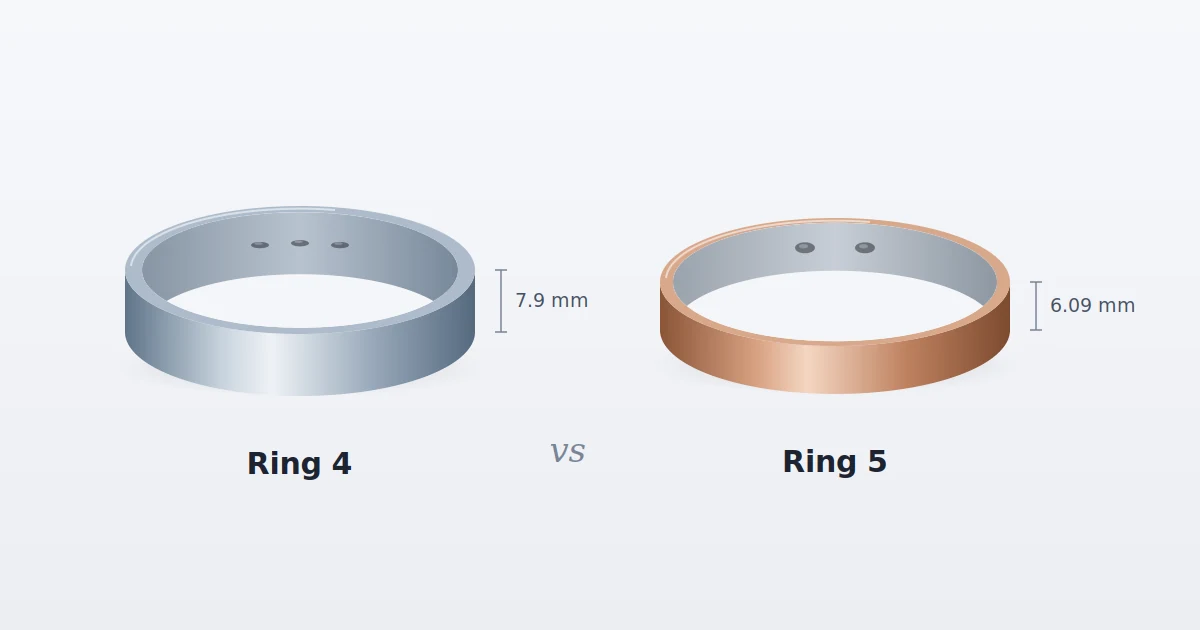
| Width | 7.9 mm | 6.09 mm |
| Thickness | ~2.88 mm | 2.28 mm |
| Weight | 3.3–5.2 g depending on size | 2.0–2.69 g depending on size |
| Inner sensor dome height | 0.3 mm | 0.7 mm |
| Optical sensors | 3 photodetectors, 2 triple LEDs (red, green, IR), up to 18 signal paths | 2 photodetectors, 2 triple LEDs (red, green, IR), 12 signal paths |
| Other sensors | Temperature sensor, accelerometer | Temperature sensor, accelerometer |
| Rated battery life | 5–8 days | 6–9 days |
| Onboard data storage | Up to 7 days | Up to 3 days |
| Sizes | 4–15 | 6–13 |
| Coating | PVD or DLC depending on finish (Ceramic edition also sold) | Superhard PVD on every finish |
| Water resistance | 100 m | 100 m (sauna and water sports, not diving) |
| Membership | Same membership for both: $5.99/month or $69.99/year. It’s tied to your account, so it carries over. | |
| Chargers and case | Size-specific and not interchangeable between generations | |
What Has Actually Changed?
The hardware changed a lot on the outside and moderately on the inside. The software experience did not change by generation at all. Sorting the differences by how much they’d affect a normal week makes the picture clearer.
Changes most Ring 4 owners would notice
Size and weight, first and by a wide margin. The heaviest Ring 5 is lighter than the lightest Ring 4. The band is almost 2 mm narrower, which moves it from “chunky tech ring” territory toward an ordinary wedding band. You’d feel this on day one.
The inside of the ring also feels different. Oura’s sensor domes on the Ring 5 stand 0.7 mm tall versus 0.3 mm on the Ring 4. Early reviewers mostly say they don’t notice them, but people who remember the bumps on the Gen3 may.
Smaller improvements that matter to specific people
Battery goes from a 5–8 day rating to 6–9. Every finish now gets the harder PVD coating, which matters if your Ring 4 picked up visible scuffs. Oura also says the new LEDs are about four times stronger, aimed at better readings across more finger types and skin tones. If your Ring 4 has given you patchy heart rate data, that’s the change to watch.
Changes that look big on paper but likely aren’t in daily use
The drop from 18 signal paths to 12 reads like a downgrade. It probably isn’t one in practice, since Oura rebuilt the optics around fewer but stronger paths. The “most accurate generation yet” line is also Oura describing its own product; independent studies take time to appear, and as of this writing the Ring 4 has more of them behind it.
One change goes the other direction and barely shows up in launch coverage: onboard storage fell from about a week to about three days. More on why that matters in the battery section.
Design and Comfort
The Ring 5 is the more comfortable ring for nearly everyone, especially overnight and during grip-heavy workouts. It’s 1.8 mm narrower, 0.6 mm thinner, and roughly 1.3 to 2.5 grams lighter depending on size.
In practical use, the thickness number matters more than the width. That 2.88 mm of titanium on the Ring 4 sits between your fingers all night and presses into the bar during deadlifts and rows. Shaving 0.6 mm off doesn’t sound like much until you think about where the ring actually lives: wedged against the neighboring finger while you sleep on your side.
Sizing is where Ring 4 owners can trip up. Oura says Ring 5 sizing is slightly different, and your Ring 4 size may not carry over. Order the Ring 5 sizing kit and wear the sizer for a full day that includes a workout and a night of sleep. Fingers swell with heat and exercise, and a slim ring that spins is a ring that reads poorly.
The size range also shrank, from 4–15 down to 6–13. If you wear a 4, 5, 14 or 15, there’s no Ring 5 for you right now, and Oura is keeping the Ring 4 on sale partly for that reason.
On durability: Oura moved every finish to a superhard PVD coating. That’s an improvement over some Ring 4 finishes, but at least one reviewer reported marks on a Ring 5 within two weeks. Titanium rings scratch. If you own the Ring 4 Ceramic edition, you already have the tougher exterior of the two, and scratches alone aren’t a reason to switch.
Health Sensors and Tracking
The Ring 5 uses fewer, stronger optical sensors, while the temperature sensor and accelerometer stay in the same roles. Any accuracy gain comes from the optical redesign, not from new types of measurement.
A quick primer, since “signal paths” gets thrown around without explanation. Oura’s rings shine light into your finger from LEDs and measure what comes back at photodetectors. Blood volume changes with each heartbeat, which changes how much light returns. Each LED-to-detector combination is a path. The Ring 4’s Smart Sensing picks the cleanest of its 18 paths as your finger position shifts. The Ring 5 has 12 paths, one fewer photodetector, much stronger LEDs, and taller domes that press the sensors closer to skin.
Does that make readings more accurate? Oura says yes. I’d frame it more narrowly: the redesign should help most when the signal is weak. Cold fingers, a loose fit, darker skin tones where light absorption is higher, restless sleep. If your Ring 4 data has been consistent, you’re unlikely to see a dramatic difference. For a broader look at where finger-based sensors are strong and where they struggle, see our breakdown of how accurate smart rings really are.
Temperature tracking is worth singling out. Oura’s temperature features, including cycle insights and the deviation you might spot when you’re coming down with something, rely on nightly trends compared to your baseline. Both rings use a digital temperature sensor for this, and Oura hasn’t claimed a temperature-sensing upgrade. Expect those trends to look the same.
SpO2 (blood oxygen) comes from the red and infrared LEDs, which both generations have. Oura hasn’t published separate SpO2 accuracy figures comparing the two.
Sleep Tracking
For sleep, the difference you’ll feel is comfort, not a different sleep report. Both rings feed the same sleep algorithm in the same app, and Oura lists detailed sleep analysis as identical across the two generations.
Consider a typical night after a couple of drinks. On either ring, you’ll see the familiar pattern: resting heart rate running higher and later into the night, HRV lower than usual, a weaker sleep score. That pattern is detected by software comparing you to your own history. A stronger optical signal might smooth out a noisy stretch of data, but it won’t change what the app concludes about a rough night.
Where the Ring 5 can change your sleep data is indirect. If you’ve been taking the Ring 4 off at night because it bothers you, or sleeping with it rotated to one side, a lighter, thinner ring that you actually keep on is worth more than any sensor spec.
Heart Rate, HRV and Recovery
Cleaner optical data could make Readiness slightly steadier, but it won’t change how Readiness works. The score still comes from comparing your resting heart rate, HRV, temperature and sleep to your personal baseline.
HRV (heart rate variability, the tiny variation in time between heartbeats) is the metric most sensitive to signal quality, because it depends on timing each beat precisely. That’s where better optics would show up first, if they show up at all. In practice, a Ring 4 owner with good fit already gets usable overnight HRV trends.
One practical note, which is my interpretation rather than anything Oura has published: any new sensor can read a little differently from the old one. If you switch, judge your recovery numbers on trends across a few weeks, not on a single odd morning after the swap.
Fitness and Activity Tracking
Oura’s fitness tools got better this year, but those improvements came through software and apply to the Ring 4 as well. The ring’s limits as a workout tracker are the same on both generations.
Live Activity Tracking, which lets you start a workout in the app and see pace, distance and heart rate in real time with lock screen widgets, rolled out June 4, 2026 for Gen3 and newer rings. Oura also improved Automatic Activity Detection for more than 40 activities, including low-motion sessions like pilates and yoga. Same eligibility: Gen3 and newer.
Neither ring has a screen, and neither replaces a watch for interval work or anything that needs a glance mid-set. Oura is strongest at telling you how recovered you are before training and how your body responded afterward. If you’re weighing a ring against a strap for training, our Oura vs Whoop comparison covers where each one fits.
For lifting specifically, the Ring 5’s slimmer band is a real quality-of-life change. Less metal sits between your fingers and the bar. Knurling will still mark either ring, though, so if you care about the finish, the old habit of moving the ring to a less-used finger during heavy pulls still applies.
Battery Life
Oura rates the Ring 5 at 6–9 days and the Ring 4 at 5–8, so on paper you gain about one day per charge. In practice, how much you gain depends on your settings, your ring size, and how old your current Ring 4 battery is.
Here’s what that extra day means on a calendar. If your Ring 4 averages six days between charges and a Ring 5 averages seven, over six weeks you’d charge seven times instead of six. One fewer charge every month and a half. Nice, but not life-changing.
The travel scenario is more interesting. On a week-long trip without the charger, a healthy Ring 5 has a better shot at making it. But the storage change cuts the other way. The Ring 5 holds about three days of data before it needs to sync with your phone; the Ring 4 holds about a week. Most people sync every day without thinking about it. If you do phone-free stretches, like backcountry hiking, a digital detox retreat, or a long festival weekend with a dead phone, the Ring 4 is the safer ring for keeping your data.
Oura says it rebuilt the Ring 5 battery chemically and mechanically for better efficiency, durability and longevity. That’s a reasonable claim, but nobody can verify long-term battery aging on a ring that’s been on sale for four months. What you can check today is your own Ring 4. The earliest units are approaching two years of daily charge cycles. If yours now needs a charger every three or four days, that’s a practical reason to upgrade that no spec sheet will tell you.
Charging takes about 80 minutes on the Ring 5. The optional Ring 5 Charging Case is size-specific and works only with Ring 5 models, so a Ring 4 case owner starts over on accessories.
Oura App and Membership
Nothing about the membership changes when you upgrade, and no major feature is locked to Ring 5 hardware. Your plan, data and history move to the new ring with your account.
Oura’s own support documentation says the Ring 5 includes the same features as the Ring 4 with an active membership, from sleep analysis and 24/7 heart rate to Cardiovascular Age, Cardio Capacity, cycle insights and Resilience. The membership costs $5.99 a month or $69.99 a year either way.
The features announced on Ring 5 launch day follow the same pattern. Health Radar, which adds Blood Pressure Signals and a 30-day Nighttime Breathing view, rolled out through July 2026 in the US, UAE and India for Gen3 and newer rings. GLP-1 Insights began rolling out in June for the same rings. Live Activity Tracking went global for Gen3 and newer. Data Deletion and the Locate feature go back even further, to Gen2.
The Android and iPhone apps get the same Oura features, and Oura hasn’t announced any platform difference tied to ring generation.
The Upgrade Question Most Comparisons Miss
Most of what you pay Oura for lives in the app, not on your finger. The Ring 5 improves how the ring collects data and how it feels to wear. It does not change what Oura does with that data.
Look at the track record. When the Ring 4 launched, the redesigned app came to Ring 3 owners too. When the Ring 5 launched, Health Radar, GLP-1 Insights and Live Activity Tracking came to both the Ring 4 and the Gen3. A ring from 2021 received a major new health-monitoring layer in 2026. That’s the pattern, and it means new hardware from Oura is mostly a wearability upgrade, with a possible signal-quality bonus.
There’s a second, quieter signal in the spec sheet. Oura cut onboard storage to three days to fit everything into a smaller body. That tells you Oura designed the Ring 5 around a phone that’s always nearby, with the heavy lifting happening in the app and in the cloud. For most users that’s fine. It also confirms where the value sits.
And the accuracy claims deserve patience. The Ring 4 has had nearly two years for independent researchers to study it. The Ring 5 has had four months. Oura has a solid research history, so its claims aren’t hollow, but “more accurate” is currently Oura’s measurement of its own product.
What Ring 4 Owners Would Actually Notice
Mostly how the ring feels, and occasionally how often you charge it. Here’s what the first few weeks would likely look like.
- You’d forget it’s on. Going from 3.3–5.2 g to 2–2.69 g is noticeable, most of all in bed and when gripping things.
- The app would look exactly the same. Same scores, same tabs, same features. The upgrade doesn’t unlock anything new on screen.
- You’d charge a bit less often. Roughly one fewer charge every five or six weeks, if Oura’s ratings hold for your size and settings.
- Your old charger and case would go in a drawer. Ring 5 accessories are separate and size-specific.
- You might end up in a different size. Ring 5 sizing runs slightly differently from Ring 4.
- The inside of the ring would feel slightly different. The taller sensor domes are subtle, but they’re there.
- Offline stretches would get riskier. Three days of storage instead of seven, if you ever leave your phone behind.
Who Probably Doesn’t Need to Upgrade
The satisfied Ring 4 owner with a healthy battery. If you still get five or more days per charge and the ring doesn’t bother you at night, the Ring 5 gives you a smaller ring and the same app. That’s a luxury purchase, not a fix.
Ring 4 Ceramic owners. You bought the tougher exterior late in the Ring 4 cycle. Durability isn’t your problem.
Sizes 4, 5, 14 and 15. There’s no Ring 5 in your size. The Ring 4 is the only current Oura ring that fits.
People who upgrade for features. If Health Radar, GLP-1 Insights or Live Activity Tracking caught your eye, they’re already on your Ring 4, depending on your region.
Phone-free travelers. Hikers, campers and anyone who disconnects for several days at a time is better served by the Ring 4’s week of storage.
Who Might Benefit From Upgrading
Anyone who takes the Ring 4 off because it’s bulky. A ring that stays on overnight produces better data than a technically superior ring on the nightstand. This is the strongest upgrade case.
Owners with a worn-out battery. If your Ring 4 now lasts three or four days and it’s out of warranty, you’re buying a new ring either way. The Ring 5 makes sense at that point.
Lifters and people who work with their hands. The narrower, thinner band sits better during grip-heavy work.
Users who’ve had patchy optical readings. If your Ring 4 regularly shows gaps or odd heart rate data despite a good fit, the stronger LEDs are aimed at exactly that problem. Oura’s claim, not yet independently confirmed, but it’s the right hardware change for it.
Should You Upgrade From Oura Ring 4 to Oura Ring 5?
Upgrade if the Ring 4 has a physical problem the Ring 5 solves: bulk, comfort, or a fading battery. Otherwise, keep your Ring 4 and let software updates keep it current.
Hardware difference. Real, but concentrated in size and weight. Sensor changes are promising and still mostly vouched for by Oura itself.
Condition of your Ring 4. Deep scratches bother some people more than others. Check the finish honestly; if it doesn’t bother you, it’s not a reason.
Battery health. This is the most practical test. Note how many days your Ring 4 lasts on your normal settings over two or three charge cycles. If it’s comfortably above five, you have time.
New health capabilities. None of the launch-day features require a Ring 5. Hardware-only features could appear later, but Oura hasn’t announced any, and buying on the hope of future exclusives is a gamble.
Software compatibility. Oura is still shipping major features to the 2021 Gen3. A Ring 4 bought in 2024 or 2025 has a long runway.
Price difference. Your membership doesn’t change, so the upgrade cost is the ring itself: $399 for Silver or Black, $499 for the other finishes, plus a new charging case if you use one. Whatever you get for your old Ring 4 reduces that.
Expected ownership period. If you plan to keep a ring three or more years, buying the newest hardware now spreads the cost further. If you’d happily wait for the next generation, the Ring 4 will carry you there.
Three Reasons to Keep Your Oura Ring 4 Longer Than You Think
1. Oura keeps feeding old rings new features. The Gen3, released in November 2021, received Health Radar, GLP-1 Insights and Live Activity Tracking in 2026. Your Ring 4 is two generations newer than that.
2. It holds a week of data offline. The Ring 5 holds about three days. For anyone who spends time away from their phone, the older ring is the more forgiving one.
3. Its accuracy has a longer independent track record. The Ring 4 has been studied by outside researchers for close to two years. The Ring 5’s accuracy story is still mostly Oura’s own, and that will take time to change.
Sources
Specs, sensor configuration, storage, sizes, battery and membership carry-over: Oura Member Care, “Discover Oura Ring 5” (updated July 27, 2026).
Also consulted: Oura’s Pulse Blog announcements “Introducing Oura Ring 5” and “New Oura Features to Help You Stay Ahead of Your Health” (May 28, 2026); Engadget’s Ring 5 launch report; Android Central’s Ring 5 vs Ring 4 weight comparison; Forbes’ Ring 5 vs Ring 4 review; Heal Nourish Grow’s two-week Ring 5 review.