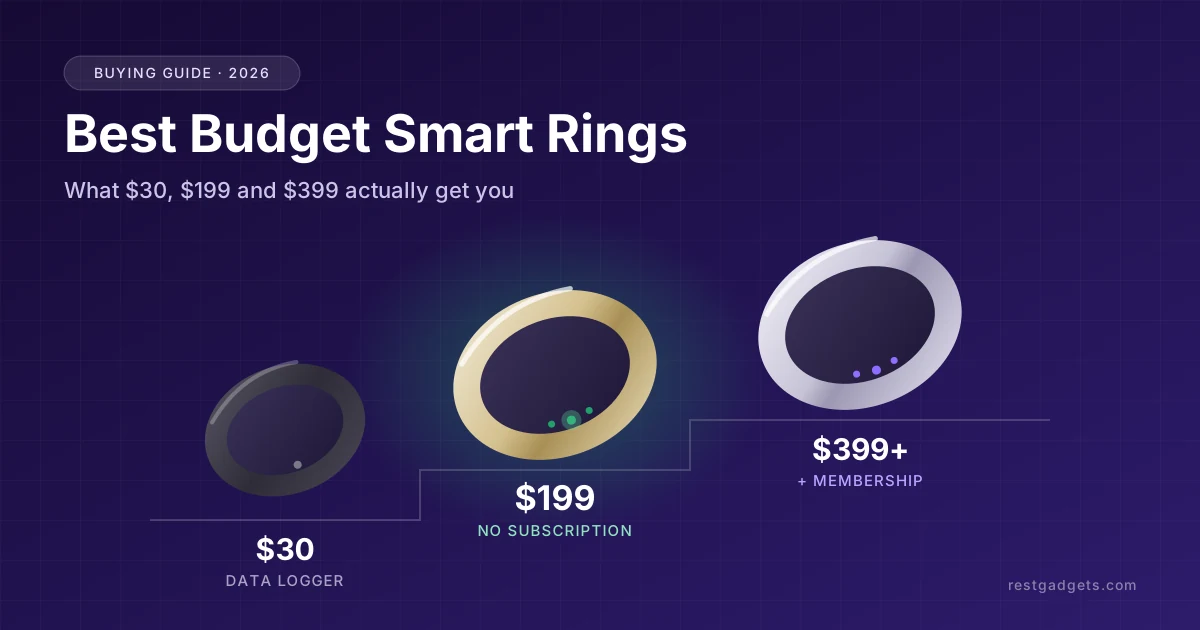
A $30 Colmi ring and a $199 RingConn Gen 2 Air advertise many of the same tracking features: heart rate, blood oxygen, HRV, sleep stages, stress. In Galaxus’s two-week review, the cheaper ring counted the reviewer’s entire time in bed as sleep and still rated the night 99 percent efficient. The gap between what a ring measures and what its software does with the measurement is a large part of what you pay for in this category.
We compared twelve rings sold, or recently sold, in the US. Among them, the RingConn Gen 2 Air is our pick for the best budget smart ring in 2026: no subscription, iPhone and Android support, multi-day battery, and a lower cost of ownership than anything else we’d recommend. Below about $150, we didn’t find a ring with enough independent evidence to rely on for more than steps and sleep timing. The ranking also shifts once you count subscriptions, battery lifespan and US legal status alongside sticker price.
The Short List
| Ring | Price | Subscription | Claimed battery | Buy it for | Main drawback |
|---|---|---|---|---|---|
| RingConn Gen 2 Air | $199 list; $159.20 Prime Day sale | None | Up to 10 days | No fees, iPhone and Android | No published sleep-staging validation; long-term battery life unproven |
| Samsung Galaxy Ring | $399.99 list; $240–$300 on sale | None | Up to 7 days | Samsung Health at a discount | Android only |
| Amazfit Helio Ring | $199.99 list; $100–$150 on sale | None | Up to 4 days | Pairing with an Amazfit watch | Short battery, three launch sizes |
| Oura Ring 4 (discounted) | $349 list; as low as $226 | $5.99/mo or $69.99/yr | Up to 8 days | Most published sleep research near this price | Membership roughly doubles 3-year cost |
| Colmi R02 / R-series | Roughly $20–$40 | None | About 5 days | Low-cost trial, open-source data access | Sleep data unreliable in published testing |
How we evaluated these rings. This is a research-based comparison, not a hands-on test; we did not wear these rings or take measurements. We started with twelve candidates, counting Colmi’s near-identical R-series as one. We checked current US prices and subscription terms against manufacturer pages and recent retailer pricing, read independent reviews from established publications, searched for polysomnography (PSG) studies of sleep staging, and read owner reviews for problems that recur across many accounts. We also checked US legal status, because several of these brands are affected by patent disputes. Prices are as of October 10, 2026, and change often.
RingConn Gen 2 Air: The Strongest Case Under $200
RingConn now sells the Gen 2 Air below its new flagship, the $349 Gen 3, which adds haptics and an automatic three-night sleep apnea assessment, according to The Gadgeteer. The Air has also been discounted: Android Authority reported a Prime-exclusive $159.20 on Amazon in early October, against a $199 recommended price. RingConn’s own store has listed it higher at times this year, so compare before buying.
No feature sits behind a subscription. The app works with iPhone and Android and syncs to Apple Health and Google Fit. RingConn rates the battery at up to 10 days; Tom’s Guide puts it at up to eight. TechAdvisor’s review described the tracking as reliable. Compared with the $299 Gen 2, you give up sleep apnea monitoring and the charging case.
Its legal footing is also steadier than most budget rivals’. After Oura’s 2025 win at the US International Trade Commission, RingConn settled and took a multi-year patent license, Android Authority reported; Ultrahuman did not, and its Ring Air was barred from import. The license resolves that dispute. It isn’t a promise about how long RingConn will support the app.
The open question is battery lifespan. Some RingConn owners on Trustpilot report rings that worked well for about a year, then dropped to a day or two per charge; these reports are not necessarily specific to the Gen 2 Air, and they aren’t a measured failure rate. Every smart ring uses a small cell that degrades and can’t be replaced, so it’s reasonable to plan for two good years rather than three. At $159, that’s about $80 a year.
If apnea screening is the reason you want a ring, this isn’t the model; that’s the Gen 2 or Gen 3.
Samsung Galaxy Ring: Only Worth It Discounted, and Only on Android
Samsung has held the list price at $399.99 since 2024, but the ring has spent most of 2026 around $275 to $300 and reached $239.99 in July. Best Buy open-box units in “excellent” condition were listed near $108 in April.
At $240 to $300 it makes sense for someone with an Android phone, ideally a Samsung, who already uses Samsung Health. There’s no subscription, and the data lands where a Galaxy Watch’s does. It does not pair with an iPhone. Samsung also uses its own sizing and recommends ordering its sizing kit first.
The Galaxy Ring is named in a complaint Oura filed with the ITC in November 2025, and Samsung has filed its own ITC complaint against Oura. We found no ruling in Oura’s case against Samsung as of this writing; check the status before you buy.
Amazfit Helio Ring: Built as a Companion, Not a First Ring
Amazfit designed the Helio for people who already own an Amazfit watch and don’t want to sleep in it. Paired that way, the Zepp app combines both devices’ data into one readiness score, and the ring only needs to cover the night. At the $100 to $150 it often sells for, against a $199.99 list, that’s a reasonable add-on. Amazfit dropped its subscription in 2024.
On its own, the trade-offs pile up. the5krunner’s spec summary lists up to four days of battery, launch sizes of only 8, 10 and 12, and early reports of connection drops that needed a factory reset. Amazfit has confirmed a Helio Ring 2 for the second half of 2026 but, as of this writing, hasn’t announced a price or date. Zepp Health, Amazfit’s parent, settled with Oura in July, and the ITC removed Zepp from Oura’s case in August; the settlement terms weren’t disclosed.
Without an Amazfit watch, another $30 to $60 buys a RingConn with roughly twice the battery and a wider size range.
Discounted Oura Ring 4: Cheap to Buy, Expensive to Keep
Since the Oura Ring 5 launched in June at $399, the Ring 4 has been discounted, falling as low as $226 on Amazon. The membership, $5.99 a month or $69.99 a year, is still required for most of the app.
Over three years, a $249 Ring 4 comes to about $459, more than twice a RingConn Gen 2 Air. The reason to consider it anyway is research. Oura reports that its Sleep Staging Algorithm 2.0 reached 79 percent agreement with PSG across four stages (wake, light, deep and REM) in a study published in Sensors by Oura-affiliated researchers. The same post cites a 2024 University of Tokyo study that tested the algorithm on the Oura Ring Gen 3 and found no significant difference from PSG. Neither study used the Ring 4, so those results are evidence about Oura’s algorithm, not a measurement of this specific hardware. It is still more published validation than we found for any other ring in this guide.
If you’d rather have Oura’s software than the lowest lifetime cost, and you’re fine with the membership as a permanent expense, a discounted Ring 4 is the way in. Our Oura Ring 5 vs WHOOP 5.0 comparison covers where the current Oura stands against a strap.
Colmi R02 and Its Siblings: A $30 Data Logger
The Colmi R02 and close relatives such as the R03, R06, R09, R10 and R12 sell for roughly $20 to $40 through marketplace sellers. The hardware holds up better than the price suggests: Galaxus found the shell unscratched after two weeks and charging from 20 to 100 percent in about 80 minutes, and one developer measured a 17mAh battery lasting around five days.
The software is the limit. Compared against a Pixel watch on the same night, Galaxus found the QRing app counted time in bed as sleep, logged one and a half REM phases to the watch’s five, and still labeled the night “excellent.” A score that can’t separate lying awake from sleeping is measuring something else.
Security is a concern too. Hardware hacker Aaron Christophel showed the R02’s firmware isn’t encrypted or signed, and the Bluetooth link needs no authentication. The upside of that openness is Gadgetbridge, an open-source app that pairs and syncs these rings without the vendor app. Gadgetbridge warns that some rings sold under the same model names use different hardware, so look for listings that name the QRing app.
Treat one as a way to find out whether you’ll wear a ring every night before spending $200 — not as a basis for sleep decisions.
What Cheap Smart Rings Get Wrong
An evidence gap. We did not find a published PSG study validating sleep staging on the RingConn Gen 2 Air, Amazfit Helio, Galaxy Ring or any Colmi model, including our top pick. That isn’t proof they’re inaccurate; it means their stage data rests on manufacturer claims and reviewers’ comparisons with other wearables. Those comparisons often show generous scoring: Wareable found the Luna Ring Gen 2 reported more deep and REM sleep than an Oura and a Garmin worn alongside it. We explain the mechanics in why smart ring sleep scores can be misleading.
Precision figures without a study behind them. Noise told reporters the Luna Ring 2 had been validated at 98.2 percent precision. Without the metric, the reference device and the test population, a number like that can’t be checked. Treat blood pressure and glucose claims on budget rings with extra skepticism.
Patents shaping availability. Ultrahuman’s Ring Air has been barred from US import since October 2025. Wareable reports the Luna Ring Gen 2 appears to have been pulled from US sale after Oura sued its parent company. RingConn and Circular reached royalty arrangements, and Zepp settled in July. Samsung’s dispute with Oura is ongoing. These cases move; check their status at the time you buy.
Also researched and left out: the RingConn Gen 3 ($349) and Gen 2 ($299), which are outside budget range; the Luna Ring Gen 2 ($329); Ultrahuman’s Ring Air and Ring Pro ($479); and the Reebok Smart Ring and Sekonda ring, whose current US pricing and support we couldn’t verify.
Budget Ring vs Premium Ring
Next to an Oura Ring 5 at $399 plus membership, the RingConn Gen 2 Air’s hardware gap is smaller than its price gap. Both track heart rate, HRV, skin temperature, blood oxygen and sleep stages; the Oura is thinner, the RingConn is rated for longer between charges. The premium mostly buys software and published research: an algorithm with peer-reviewed results behind it and a more developed app. It doesn’t buy more sensors or longer battery life. For the higher end, see our guide to the best smart rings for sleep tracking.
What We’d Buy at $50, $100 and $200
At $50: a Colmi R02 or R10 from a listing that names the QRing app, as an experiment. Among the rings we examined, none at this price had enough independent evidence to rely on for sleep stages.
At $100: an Amazfit Helio on sale, if you own an Amazfit watch. Without one, we’d wait for a RingConn deal.
At $200: the RingConn Gen 2 Air, ideally on sale. On Android with Samsung Health, a Galaxy Ring around $240 is the alternative.
Common Questions
Are cheap smart rings accurate?
For steps, resting heart rate and sleep timing, often close enough. For sleep stages, we didn’t find enough independent validation on any ring under $200. In one published review, a $30 ring counted time in bed as sleep. Read budget-ring stage data as a rough trend.
What is the best smart ring without a subscription?
Among the rings we compared, the RingConn Gen 2 Air: $199 list, often less, with no paid features and support for iPhone and Android. Android users already using Samsung Health can also consider a discounted Galaxy Ring, which likewise charges no subscription.
Can a budget smart ring track sleep reliably?
It can usually track when you sleep; how well you slept is harder. Bedtime, wake time and duration are the most dependable outputs on cheap rings. Stage breakdowns and scores vary, and some apps grade generously, so multi-week trends tell you more than any single night.
Do cheap smart rings work with iPhones?
Most do. The RingConn Gen 2 Air, Amazfit Helio, Oura Ring 4 and Colmi’s QRing app all support iOS. The Samsung Galaxy Ring is the exception: it pairs only with Android phones, however low its price falls.
Is a $50 smart ring worth buying?
As an experiment, yes. A Colmi-class ring logs steps, heart rate and approximate sleep timing, and it’s a cheap way to learn whether you’ll wear a ring nightly. If you plan to act on the data, it doesn’t replace a ring in the $159–$199 range.