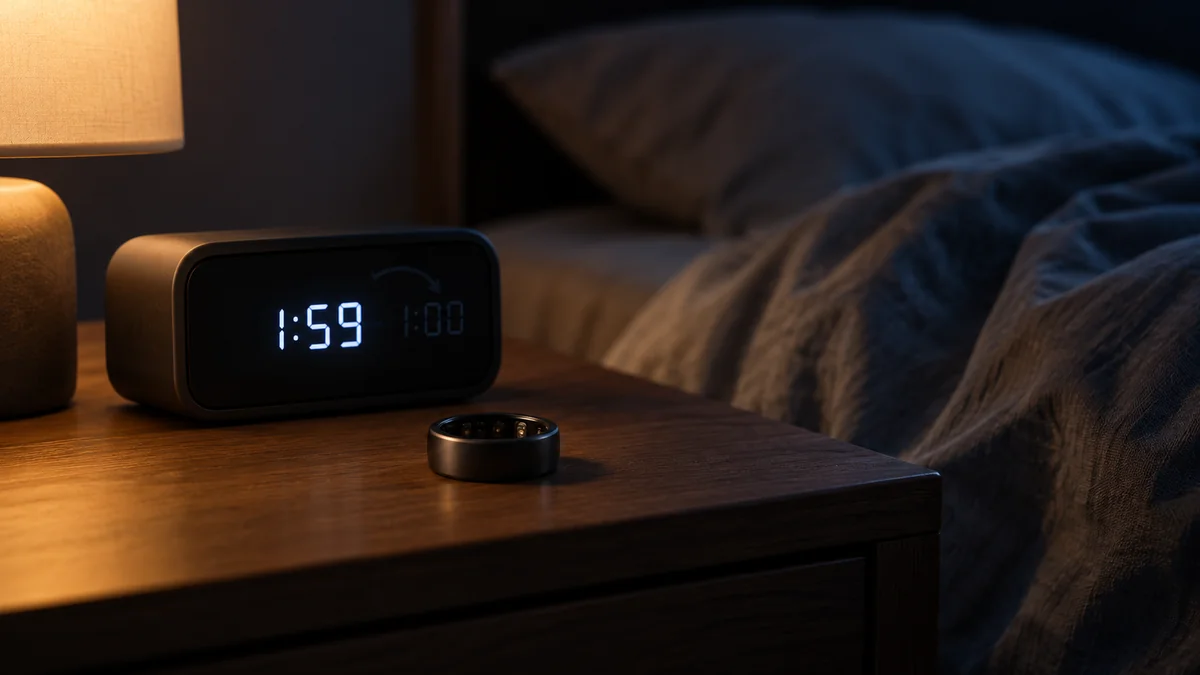
Short answer: After clocks fall back on November 1, 2026, expect your sleep tracker to show more awake time, a slightly higher resting heart rate and a lower readiness score for three to five nights. That’s your body clock catching up, not a sleep problem. Compare each night to your own baseline from the week before, and judge the week by the trend rather than any single score.
Clocks in the US fall back at 2 a.m. on Sunday, November 1, 2026. Most people treat it as a free hour. Your sleep tracker won’t. If you wear an Oura ring, a WHOOP strap or a watch to bed, the week after the change is one of the few times a year when the data looks bad and the cause is completly obvious. That makes it a useful week, as long as you know which numbers to trust and which ones to wait out.
This isn’t a “go to bed early and drink less coffee” post. You’ve read that one. This is about what the wearable actually shows during the shift, why some features get it wrong for a few days, and how to use the data to get back on schedule faster.
The “extra hour” mostly doesn’t show up
The clock moves an hour. Your body clock doesn’t. It’s set by light, and it moves slowly, roughly in small daily steps rather than a single jump. A small 2008 study in BMC Physiology tracked people with wrist actigraphy around both clock changes and found that adjusment still wasn’t complete four days after the switch. Night-time restlessness went up in both directions.
Oura has its own version of this, and it’s the more interesting number for anyone wearing a ring. After the fall 2025 change, Oura told Axios that across more than 76,000 members, average awake time in bed rose about 2% the following week compared with the week before. Resting heart rate went up, sedentary time went up, and total sleep went down. So the group that supposedly gained an hour slept a little less.
A regional cut of the same data for Georgia members showed the scale of it: awake time up 2.2%, resting heart rate up 0.25%, steps down 2.61%, total sleep down 0.49%. None of those are dramtic on their own. Together they describe a body that’s slightly out of sync for about a week.
Who gets hit harder (it’s not who you’d think)
Most people assume night owls struggle with every clock change. In the fall, it’s the other way around. The same BMC Physiology group found the spring shift was harder on evening types, and the fall shift was harder on morning types. A lark who normally wakes at 6:00 will start waking at 5:00 on the new clock, but still feel sleepy at their usual bedtime. Net result: less sleep, not more.
If your tracker gives you a chronotype, check it before November 1. Oura assigns one after 40 to 90 days of wear, and since March 2026 it’s dynamic, so the app will flag it if your timing drifts. An “early morning” or “morning” label is your early warning that this week will feel worse than the hype suggests.
What a normal fall-back week looks like on your tracker
Here’s the pattern I’d expect for a typical person who does nothing special to prepare. It’s an illustration built from the research above, not a single person’s data, but it’s the shape to look for in your own trends.
The first night or two after the change, the clearest signal is early waking: you’ll wake before your alarm and lie there. That shows up as more awake time and a lower efficiency number. By night four or five most people are close to baseline. If you’re still well off after a full week, it’s probably not the clock anymore. Something else is going on.
Three tracker features that get confused this week
Bedtime guidance. Oura’s Bedtime Guidance is calculated from your recent wake-up times, while Body Clock is based on your chronotype. For a few days after November 1, those two will disagree, because your recent history is still on summer time. Guidance will lag. I’d lean on the Body Clock window this week and let guidance catch up.
Readiness and recovery scores. A small bump in resting heart rate and a dip in HRV will pull readiness down even if you feel fine. That doesn’t mean you’re getting sick. It’s the same reason a single bad night shouldn’t rewrite your training plan, which I covered in why smart ring sleep scores can be misleading. Look at the 7-day trend, not Monday’s number.
Sleep stages. Don’t read too much into one night of “less deep sleep” right after the switch. Consumer wearables are good at trends and much weaker at night-by-night stage splits. If you want the details on how far to trust stage data, the smart ring accuracy breakdown goes through the research.
Which metric to watch, and how to read it
| Metric | What it’ll likely do this week | How to read it |
|---|---|---|
| Total sleep | Flat or slightly down, not up | Use the 7-day average, not one night |
| Awake time in bed | Rises first, settles by night 4–5 | Your best signal that you’ve adjusted |
| Resting heart rate | Small bump | Compare to your own baseline, not a general “normal” |
| HRV | May dip a little | One low reading doesn’t mean you’re getting sick |
| Sleep stages | Can look odd for a night or two | Treat as estimates; ignore single-night swings |
| Readiness / recovery | Lower than usual | Read it alongside how you actually feel |
If you only check one number, make it awake time. It’s the one that moves most clearly with the clock change and the first one to come back.
A tracker-based plan for the week
The usual advice from sleep clinics is to shift your schedule in small steps. The RWJ sleep center suggests moving bedtime and wake time about 15 minutes every one to two days. Your wearable just lets you check whether it’s working instead of guessing.
- Get a baseline this week. Write down your 7-day average for total sleep, awake time and resting heart rate now, before October ends. You’ll want something to compare against.
- Start sliding later from about Wednesday, October 28. Push bedtime 15 minutes later every night or two. This sounds backwards, but on the new clock a 10:45 p.m. summer bedtime becomes 9:45. Going later first means you land closer to your usual time.
- Morning light on Sunday and Monday. The fall change gives you brighter mornings. Use it. Light right after waking is the main signal that anchors your clock, and it’s the one thing on this list that costs nothing.
- Watch awake time, not the score. If awake time in bed is back near your baseline by Thursday or Friday, you’ve adjusted. If early waking is still there, try a dim, cool bedroom in the morning hours and avoid bright screens before your new bedtime.
- Morning types: be stricter. If your chronotype is early, protect the last hour of sleep with blackout curtains or a mask for the first few nights, since that’s where you’ll lose time.
Here’s what step 2 looks like for someone whose usual bedtime is 10:45 p.m.:
One thing I’d skip: going to bed an hour “early” on Saturday night to bank sleep. If you aren’t sleepy, you’ll just lie there, and your tracker will show exactly that.
Does it matter which wearable you use?
For this specific job, not much. You need three things: total sleep, time awake in bed and resting heart rate, plus a trend view across a week. Oura, WHOOP, Galaxy Ring and recent watches all cover that. Where they differ is in how they explain it to you. Oura’s chronotype and Body Clock features are the most direct fit for a clock change. WHOOP leans more on strain and recovery, which is useful if you train hard and want to know whether to back off that week. I compared the two in more depth in Oura Ring 5 vs WHOOP 5.0.
The short version
You’ll probably sleep a bit worse, not better, for three to five nights after November 1, especially if you’re a morning person. Your readiness score will dip for reasons that have nothing to do with fitness or illness, and bedtime guidance will run behind for a few days. Take a baseline now, shift later in 15-minute steps, get light in the morning and judge the week by awake time and the 7-day trend. If the numbers aren’t back after a week, look for a different cause.
Frequently asked questions
Why does my sleep tracker show worse sleep after daylight saving time ends?
Because your body clock doesn’t move with the wall clock. You’ll tend to wake earlier than you want for the first few nights, which shows up as more awake time in bed and lower efficiency. Oura’s own data from fall 2025 showed members actually slept a little less the week after the change, not more.
Does daylight saving time affect Oura Ring scores?
Yes, mostly through readiness. Resting heart rate tends to tick up and awake time rises, so readiness drops for a few days. Bedtime Guidance also lags, since it’s based on your recent wake-up times, which were still on summer time. Body Clock is the better guide that week.
How many days does it take to adjust to the fall time change?
For most people, three to five nights. Research found adjustment still wasn’t complete four days after the switch, and morning types usually take longer than night owls in the fall. If you’re still off after a full week, the clock probably isn’t the reason anymore.
Should I trust my sleep stages after the clock change?
Not night by night. Consumer wearables are reasonably good at trends and much weaker at exact deep and REM splits. A strange-looking stage chart on Sunday or Monday night isn’t worth worrying about.
Should I change my bedtime before November 1?
If you want to, shift later, not earlier, in 15-minute steps every night or two starting around October 28. That way your bedtime on the new clock lands closer to normal. Don’t force it, though. Lying in bed when you aren’t sleepy just adds awake time.