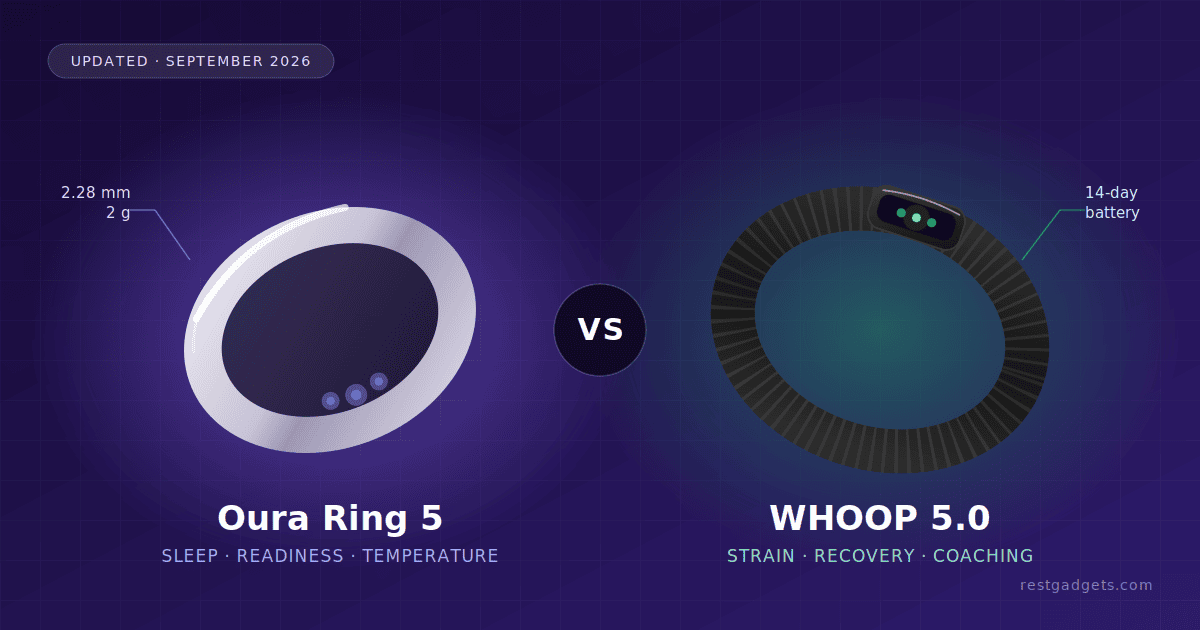
Oura Ring 5 vs WHOOP 5.0 is the comparison I get asked about most, and the answer changed in May 2026. The original version of this article put the Oura Ring 4 against WHOOP 5.0 and called it close: Oura won on sleep and comfort, WHOOP won on training and battery, and Oura was cheaper over three years. Then Oura released a ring 40 percent smaller than the Ring 4, raised the base price to $399, and changed almost nothing in the app. WHOOP hasn’t touched its hardware or pricing since its own launch a year earlier. So one side of this comparison moved and the other stayed put, and the interesting question is whether the move was in a direction that matters.
I’ve worn the Ring 5 since the first week it shipped. For the first month I kept my Ring 4 on the other hand so I could compare nightly readings, and WHOOP 5.0 has stayed on my bicep through all of it. What follows is where each device earns its money now, and where the old verdict no longer holds.
What Actually Changed With the Ring 5
Almost everything that changed is physical. The Ring 5 is 6.1mm wide and 2.28mm thick, down from 7.9mm and 2.8mm on the Ring 4, and the smallest sizes weigh two grams. Those numbers undersell it. The Ring 4 was already comfortable to sleep in; the Ring 5 stops registering as an object on your hand within a couple of days. I’ve reached for it in the shower to take it off and found I’d already forgotten it was there.
The sensor redesign is the part worth understanding before you buy. Oura reduced the number of optical light paths from 18 to 12, then made each LED roughly four times brighter and lowered the sensor domes so they sit closer to the skin. Fewer sensors reads like a downgrade on a spec sheet. In practice, over the month I wore both rings side by side, the Ring 5 logged fewer nights with gaps in HRV data and its resting heart rate line was slightly smoother. Oura’s claim is that the brighter LEDs improve signal across a wider range of finger sizes and skin tones. I can’t verify the skin tone part from one hand, but my own data didn’t argue with it.
What didn’t change: the app, the three morning scores, the metrics, the membership price. Every software feature Oura has released since — Cardiovascular Age, the Blood Pressure Profile, the GLP-1 tracking module I covered in June — went to Ring 4 owners as well. If you own a Ring 4 that fits, the upgrade buys you comfort and about a day of battery, nothing else.
What You’re Paying, Three Years Out
The pricing models are unchanged and still fundamentally different. Oura sells you a ring — $399 in Silver or Black, $499 for Gold, Stealth, Brushed Silver, or Deep Rose, and the extra hundred dollars is a coating, not a material — then charges $5.99 a month or $69.99 a year for anything beyond the headline scores. WHOOP sells you nothing; you subscribe, and the hardware arrives with the membership. WHOOP One is $199 a year with a basic charger, Peak is $239 with the wireless PowerPack and the Healthspan and Stress Monitor features, and Life is $359 and swaps the 5.0 for the WHOOP MG, which is the only way to get ECG.
When this was a Ring 4 comparison, Oura won on cost against every WHOOP tier. It no longer does. The Ring 5 and WHOOP One land within twelve dollars of each other over three years, and WHOOP’s membership includes hardware coverage for as long as you stay subscribed, which has real value if you’re the type who wears a tracker for five years and would otherwise be buying a Ring 6. Oura still beats Peak by about a hundred dollars, and Peak is the tier most WHOOP reviewers, myself included, would actually recommend.
The quiet winner of this chart is the Ring 4. Oura kept it on sale, frequently at $349 or under, and it runs the same app with the same metrics. If your fingers fit it and you don’t need the slimmer band, it’s the cheapest correct way into the Oura ecosystem right now.
Sleep Tracking
This is still where Oura’s form factor pays off. A finger-worn sensor sits closer to arterial blood flow than anything on the wrist, and that shows up as steadier overnight HRV and slightly more consistent sleep staging. The Ring 5 held that edge over WHOOP without widening it — it is as accurate as the Ring 4, not more accurate than WHOOP by a bigger margin than before.
The Oura morning report is the same as it’s been: Sleep, Readiness, and Activity scores, with sleep broken into stages, latency, efficiency, timing, and restlessness, presented in a way that contextualizes rather than scolds. The temperature trend line remains the feature I’d least want to give up. A persistent half-degree deviation across two or three nights has flagged an oncoming cold before I felt it, every single time, in eighteen months of wearing Oura. WHOOP tracks skin temperature too, but the wrist produces noisier overnight readings and it has never caught one first.
WHOOP’s sleep tracking exists in service of one number. The band samples 26 times a second and everything in the app funnels into a morning Recovery percentage and a daily Strain target. Sleep staging is roughly on par with Oura in controlled comparisons, with a small REM lag that’s been noted in independent testing and that I’ve seen in my own data on nights where the two devices disagreed.
What WHOOP has that Oura doesn’t, and what I’d argue matters more to most people than a few percentage points of staging accuracy, is the haptic alarm. Set a window, and the band wakes you at a reasonable point in your sleep cycle by vibrating against your arm — nobody else in the bed hears it. Oura has nothing comparable. After a year and a half with both, this is the single feature that most changes how mornings feel, and it lives on the device I’d otherwise call the worse sleep tracker.
Recovery, and What Each Device Means by It
Both give you a daily readiness number. What they mean by it is where the Oura Ring 5 vs WHOOP 5.0 decision actually gets made.
Oura’s Readiness Score folds sleep, activity balance, body temperature, HRV, resting heart rate, and recent load into a single read on how prepared you are for whatever the day contains. A tempo run and a day of back-to-back meetings get the same score. The tone is deliberately soft — Oura Advisor reads like a calm coach and nudges rather than instructs.
WHOOP’s Recovery Score is a training tool. It sits inside a closed loop with Strain and Sleep and tells you not just how recovered you are but roughly how much Strain your body can absorb today. WHOOP Coach reads all of it, remembers past conversations, and will hold an actual back-and-forth about whether to push or back off. For anyone following a structured plan that’s a different category of usefulness, and Oura doesn’t try to compete with it.
The loop is also WHOOP’s weak point. Strain is calculated from heart rate, and wrist-worn WHOOP heart rate still drifts during hard intervals. A bad HIIT session can produce a Strain number that’s meaningfully off and a Recovery reading the next morning that doesn’t match how you feel. Wearing the band on the bicep helps noticeably; a chest strap paired through the app fixes it. Oura doesn’t have this problem because Oura isn’t really trying to measure your workouts — its automatic activity detection is inconsistent and active-calorie estimates lag well behind any wrist device, which is a different problem but at least an honest one.
Battery and Sizing
Oura rates the Ring 5 at six to nine days, up from five to eight on the Ring 4. My size-10 unit went eight days and twenty hours on its first full cycle and has settled around eight since. Squeezing a longer runtime out of a body 40 percent smaller is a real engineering result, though Oura batteries have historically lost capacity over a couple of years and I’d expect the Ring 5 to follow. A full charge takes about 80 minutes. The optional $99 charging case gives roughly a day of charge in ten minutes and works as a travel case, but like the charger it’s size-specific.
WHOOP 5.0 still clears fourteen days comfortably, and the wireless PowerPack that comes with Peak and Life charges the band on your arm. This remains the biggest practical advantage WHOOP has over every ring on the market, and it isn’t close.
Sizing is the one place the Ring 5 is a step backward. It ships in sizes 6 through 13; the Ring 4 covered 4 through 15. If you wore a Ring 4 at either extreme, there’s no Ring 5 for you yet. And because the thinner band sits differently on the finger, I’d order the free sizing kit even if you’re certain of your size, and wear the sizer for two full days including a night.
Where Both Are Reaching Beyond Sleep
Oura Ring 5 tracks nocturnal SpO2, respiratory rate, cycle insights, and temperature deviation, and now offers Cardiovascular Age and a Blood Pressure Profile. The Blood Pressure Profile sat on “calibrating” for most of three weeks on my unit before it produced anything. There’s no ECG, and for most people who aren’t specifically watching for atrial fibrillation that continues not to matter.
WHOOP’s additions run further into clinical territory: Healthspan, which builds a “WHOOP Age” from nine markers; Blood Pressure Insights; and, on the MG, an FDA-cleared ECG for on-demand AFib checks. Advanced Labs, which folds blood test results into the app and was only teased at launch, is now live.
If ECG is why you’re considering WHOOP, the relevant price is $359 a year, not $199. The MG only comes with Life, and ECG isn’t offered to users under 22 or to anyone with a pacemaker or other implanted electronic device.
The Honest Case Against Each
The Ring 5 is a physical redesign sold at a premium, with no sensor capability Ring 4 owners don’t also get through the app. The size range shrank. A hundred dollars for a color is hard to defend. And it remains a seventy-dollar annual subscription on top of a four-hundred-dollar ring, indefinitely — Oura has been clear that the ring is close to useless without membership, and nothing about the Ring 5 changes that.
WHOOP has the exercise heart rate problem, the hardware-you-never-own problem, and a strap that a meaningful share of people simply cannot sleep in. Its pricing hasn’t moved in over a year, which is stable but not generous, and the tier structure steers hard toward Peak whether or not you want Healthspan. The launch-week upgrade-fee mess from May 2025 is resolved, but it’s worth remembering that this is a company that once tried to charge existing members for hardware it had promised them.
Which One to Buy
After a summer wearing both, the split held. The Ring 5 made Oura’s case on comfort close to unanswerable and did nothing for its case on price. WHOOP stood still and, on training, still leads.
Buy the Oura Ring 5 if you sleep badly and want to understand why, if you’ll forget to charge anything you can feel on your body, or if you already own a sports watch for workouts and want a health companion rather than a coach. Buy WHOOP 5.0 if you train on a plan and want Recovery to actually dictate your day, if a smart alarm sounds like it would change your mornings, or if two weeks of battery matters more to you than a millimeter of thickness. Buy a discounted Ring 4 if you’re in the middle and your fingers fit one. And if you’re looking at either of these because you want a screenless tracker and aren’t sold on a ring or a strap specifically, the full wearables roundup covers the watches and bands that sit between them.
Oura tells you things about your body you didn’t ask about. WHOOP answers the one question you did.
Use WHOOP’s 30-day trial and sleep in the band for at least ten nights; if it bothers you on night two, it’ll bother you on night thirty. Both devices need a couple of weeks of consistent overnight wear before the baseline means anything. Neither is a medical device, and anything they flag belongs in front of a clinician rather than in a settings menu. If you want to see how the Ring 5 holds up against Samsung, RingConn, and Ultrahuman rather than against a strap, that’s in the smart ring sleep tracking guide.
Quick Reference
| Oura Ring 5 | WHOOP 5.0 | |
|---|---|---|
| Worn | Finger, 2 g, 2.28 mm thick | Wrist, bicep, or body |
| Upfront | $399 / $499 by finish | $0 |
| Subscription | $5.99/mo or $69.99/yr | $199 / $239 / $359 per year |
| Battery | 6–9 days | 14+ days, on-body charging |
| Sleep staging | Best in class | Close second, slight REM lag |
| Exercise HR | Weak | Good on bicep, drifts on wrist |
| Smart alarm | No | Yes, haptic |
| ECG | No | MG only, Life tier |
| Water resistance | 100 m | 10 m |
| Sizes | 6–13 | Adjustable |
Frequently Asked Questions
Is Oura Ring 5 better than WHOOP 5.0?
For sleep tracking and comfort, yes. For training guidance, recovery-based coaching, and battery life, WHOOP 5.0 is the stronger device. They’re built for different priorities rather than one being better outright.
What’s the difference between Oura Ring 5 and Ring 4?
The Ring 5 is about 40 percent smaller and lighter, gets six to nine days of battery instead of five to eight, and costs $50 more. The optical sensors were redesigned but the app, metrics, and membership are identical, and Ring 4 owners get every new software feature.
Which is more accurate for sleep tracking?
Oura Ring 5 holds a small edge on overnight HRV and sleep staging because finger-worn sensors sit closer to arterial blood flow. WHOOP 5.0 is close behind and is more accurate during exercise, especially worn on the bicep.
Do both require a subscription?
Yes. Oura Ring 5 needs a $5.99/month or $69.99/year membership for full features on top of the ring. WHOOP is subscription-only, from $199 to $359 a year, with the hardware included.
How much does Oura Ring 5 cost versus WHOOP over three years?
About $609 for a Ring 5 in Silver with annual membership, versus $597 for WHOOP One or $717 for WHOOP Peak. The Ring 5 price increase closed most of the gap that existed with the Ring 4.
1 thought on “Oura Ring 5 vs WHOOP 5.0: Which Is Better for Sleep & Recovery in 2026”